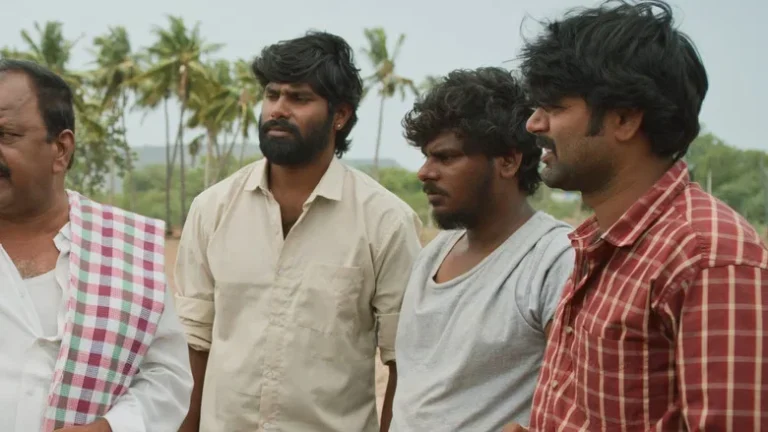
In 1990s Thimmarajupalli, Rajappa brings home the village’s first television after his marriage. His modest house transforms into the community’s gathering centre overnight. Satish, a young man caught in quiet romance with Sarada, uses the nightly screenings as cover to glimpse the girl whose father keeps her carefully guarded. The setup is familiar, the textures specific, and within these opening beats V. Muniraju signals a film more interested in sociology than melodrama, until the TV vanishes and the whodunnit machinery starts grinding.

Cinematography Anchors Authenticity Before Story Does
The film’s strongest asset sits in its location work. Shot entirely in the actual village of Thimmarajupalli, the visuals carry an unrehearsed quality that no art direction budget could fake. Dust settles naturally on courtyards. Faces carry the sun’s imprint without theatrical lighting. This grounded aesthetic does half the work of establishing period and place before a single plot point lands. When Rajappa’s neighbours crowd his veranda to watch Chiranjeevi flicker on screen, the frame composition isolates individual reactions, pride, envy, wonder, without underlining them. The camera trusts the setting to do the storytelling, and for long stretches, it does.
Satish and the Ensemble Navigate Thin Character Arcs
Satish, played by Sai Tej, carries the film’s central investigation with a restrained register that suits the milieu but rarely shifts gear. His romance with Sarada unfolds in stolen glances during communal TV nights, a device that works until the theft accusation forces him into reactive mode. The performance stays within naturalistic boundaries, which serves the film’s realism but leaves dramatic peaks underexplored. Veda Jalandharr as Sarada registers more as narrative function than character, her presence motivates Satish’s actions without carving much independent space.
Pradeep Kotte’s Rajappa holds the film’s emotional centre more convincingly. His pride in owning the TV, his wounded authority when it’s stolen, and his suspicion toward Satish carry the weight of a man whose status symbol becomes his cage. The role demands more bitterness than charm, and Kotte leans into that without softening edges. Swathi Karimireddy as Ellamma and supporting players like Amma Ramesh and Satyanarayana populate the village convincingly, though the script rations them moments rather than arcs. Their casting signals Muniraju’s commitment to ensemble texture over star hierarchy, even if budget constraints show in underwritten secondary threads.
Drama Mechanics Stumble Before Finding Footing
The first half moves with the pace of village time, deliberate, observant, occasionally inert. Muniraju spends forty minutes establishing community rhythms and romantic longing before introducing the theft that will drive the second act. This extended setup feels like ethnographic patience until you realise it’s narrative stalling. Character beats repeat. Scenes of villagers gathering for TV programs recycle visual ideas without deepening stakes.
Once the TV disappears and Satish faces a two-week deadline to find the real thief, the film remembers it promised a whodunnit. The investigation mechanics remain modest, no forensic flourishes, no red herring architecture, but the tempo shifts noticeably. Muniraju sustains curiosity around the theft without overplaying suspense. The climax resolves threads neatly, if predictably, and the whodunnit elements land more as character reveals than plot twists.
The screenplay’s linearity works against tonal variation. No subplots complicate the main investigation. No tonal detours interrupt the earnest rural drama register. This simplicity reads as clarity in some stretches and thinness in others. Gulte awarded the film 2.5 out of 5, citing both its nostalgic authenticity and its sluggish first-half pacing as defining traits. I found myself agreeing more with the first-half critique than the nostalgia claim, the 90s setting feels incidental rather than mined for dramatic specificity.
For viewers curious about how Telugu Drama reviews evaluate regional storytelling mechanics, this film offers a case study in rural realism constrained by budget and pacing choices.
Direction Chooses Observation Over Acceleration
Muniraju, who also scripted the film, approaches the material with a documentarian’s eye and a dramatist’s caution. His strength lies in sustaining suspense around the theft once it occurs, he parcels out information deliberately and avoids cheap gotcha moments. The climax resolves character tensions without overreaching. His weakness shows in the protracted first act, where patience curdles into repetition. Scenes establishing Satish’s love for Sarada and the village’s TV dependency overstay their purpose. A tighter first half would have let the whodunnit breathe without feeling like narrative compensation.
No Controversy, Only Modest Theatrical Reception
The film arrived without political noise or casting drama. Produced by Kiran Abbavaram under KA Productions and Sumaira Studios, it positioned itself as a small-scale theatrical release banking on content over star power. Limited budget constraints, noted by Gulte, show in production design choices and the compressed supporting cast. Reception remained muted, no box office figures surfaced, no social media wave followed. The film played to audiences already invested in rural dramas and period nostalgia, a niche that doesn’t expand easily without breakout word-of-mouth.
Thimmarajupalli TV rewards patience in its second half but demands too much of it in the first. If you’re drawn to films where community dynamics and stolen household objects drive quiet investigation, this will hold your attention once it stops circling its premise. Best suited for a home watch where you can skip through repetitive setup scenes. The authentic village setting and grounded performances deserve notice, but the film never shakes off the feeling that it’s stretching a short film premise to feature length.
V. Muniraju’s rural whodunnit finds its rhythm only after the TV goes missing, making Thimmarajupalli TV a modestly effective drama worth 2.5 out of 5 for patient viewers.
Muniraju’s choice to ground suspense in rural ego clashes rather than procedural mechanics mirrors the approach Jana Nayagan review takes with its own community-driven conflict.
Where this film opts for slow-burn sociology, Inkosari Chapter verdict leans harder into genre structure and leaves more threads deliberately unresolved.