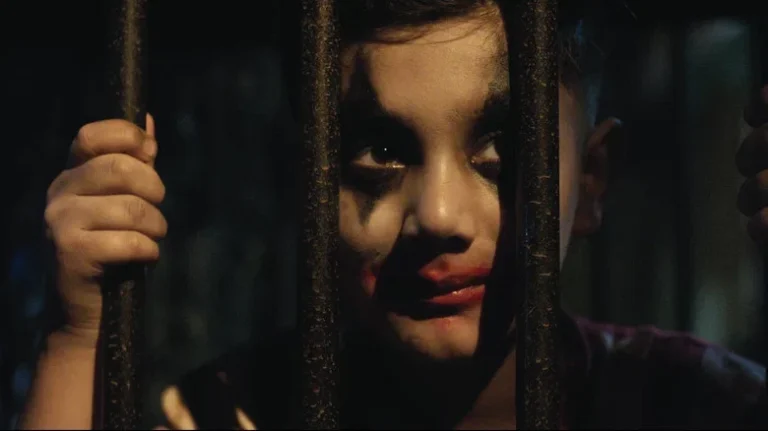
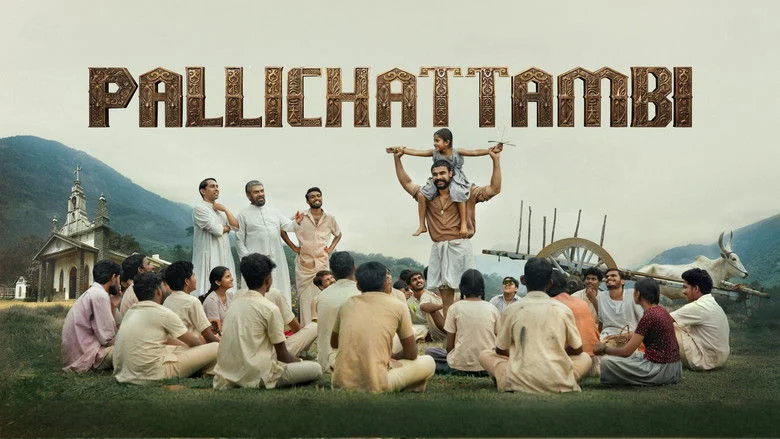
An easy-going youth from Thomapuram arrives in Kaniyaar hamlet, dispatched by the Church as muscle to suppress communist voices during Kerala’s 1950s Vimochana Samaram. He carries his grit in clenched fists, unaware that ideology will soon rewire his loyalties. Within these opening strokes, Dijo Jose Antony sketches a man poised between obedience and awakening, and Tovino Thomas wears that duality without flinching.
Tovino Thomas Plays Two Men in One Body
Thomas anchors the film through a dual register: the Yakshaganam artist inhabiting Ravana’s rage on stage, and the goon who channels that same ferocity into enforcing Church will off it. He modulates between the two without theatrical excess. The physical weight he brings to confrontations feels rooted in manual labor and old grudges, not gym-built swagger. When the script demands ideological evolution, Thomas recalibrates his gaze and posture to signal the shift, without a single monologue spelling it out. Times of India awarded the film 3.0, noting it gives Thomas a memorable role. That assessment understates how thoroughly he owns every frame.
Dijo Jose Antony Chooses Scale Over Subtlety
Antony builds a largely compelling narrative around Kerala’s first democratic churn, embedding the protagonist’s journey within church-communist friction. His strength lies in integrating characters with purpose rather than decoration, each supporting player serves the ideological scaffolding. Yet the direction prefers tried and tested approaches when the material begs for formal risk.
The screenplay, penned by Suresh Babu and S. Suresh, moves linearly through historical flashpoints without structural detours, as also noted in coverage by Hdhub4u. It discusses ideas on multiple levels but rarely interrogates them beyond the surface of partisan conflict. The fantastical turn toward the climax arrives without sufficient tonal preparation, jarring against the grounded realism that precedes it.
Period Craft Anchors Spectacle in 1950s Kerala
The Vimochana Samaram backdrop is more than setting, it functions as the film’s ideological engine. Antony stages the escalating church-communist tensions through public squares and hamlet meetings, using crowd choreography to signal shifting power. The protagonist’s identity as a Yakshaganam artist folds cultural practice into political awakening, though the film leans harder on spectacle than on excavating what those performances mean to him personally.
Action sequences privilege spatial clarity over chaos. When the protagonist confronts rival factions, the camera holds wide enough to track the geography of violence. These setpieces feel proportional to the stakes, no inflated heroism, just survival mechanics. The problem emerges when the film tries to layer fantastical elements onto this texture. The tonal rupture suggests Antony wanted mythic elevation but couldn’t reconcile it with the earthy realism he’d established.
The period design doesn’t overreach. Costumes and production details sketch 1950s rural Kerala without museum polish. The film trusts its milieu enough to avoid constant exposition, though it could have pressed deeper into how ideology rewires everyday relationships. Instead, it foregrounds spectacle over intimate ideological friction, keeping emotional payoffs muted.
Sudheer Karamana and Vijayaraghavan Anchor the Ensemble Weight
Sudheer Karamana and Vijayaraghavan populate the church-communist divide with veteran presence, lending institutional gravity to what could have been cardboard factions. Karamana’s casting signals that the Church authority here isn’t monolithic villainy but calculated pragmatism. Vijayaraghavan grounds the communist side with weary conviction rather than firebrand theatrics. Johny Antony and Kayadu Lohar fill supporting roles that service the plot’s structural needs more than they expand character psychology. The ensemble works in service of the central ideological contest, but the script rarely grants them moments to breathe outside their factional duties.
If you track Malayalam action dramas built around political upheaval, Malayalam Action reviews on this site explore similar terrain with varied tonal registers.
Audience Will Measure Patience Against Payoff
The film demands patience through its two-and-a-half-hour runtime, rewarding viewers willing to sit with ideological debate more than those hunting kinetic thrills. It positions Thomas as both action lead and political vessel, and the balance tilts more persuasively toward the former. The fantastical climax will divide audiences, some will read it as myth-making, others as tonal miscalculation. Those who value period authenticity over narrative economy will find enough texture here. Those expecting tight pacing and consistent realism will leave frustrated by the bloated middle and the unearned mythic turn.
Catch this on the largest screen available if period action spectacle matters to you. The film’s scale demands theatrical immersion, even if the script doesn’t always earn that grandeur. Tovino Thomas delivers enough conviction to carry the ideological weight, but Dijo Jose Antony’s reluctance to take formal risks keeps the film grounded in spectacle rather than transcendence. I found myself wishing the fantastical finale had either been seeded earlier or excised entirely, it lands as ambition without preparation.
Thimmarajupalli TV review similarly pairs cultural authenticity with uneven payoffs, though that film trades period weight for contemporary immediacy.
Pallichattambi is a watchable period drama anchored by Tovino Thomas’s controlled performance and Antony’s commitment to spectacle, even if the tonal inconsistencies and fantastical overreach keep it from greatness, a solid 3 out of 5. Jana Nayagan verdict mirrors how Pallichattambi struggles to sustain momentum across its extended second act, though both films anchor their flaws with committed lead turns.