Sarvagunn Sampann (2026): A Sharp Premise Undone by Timid Execution
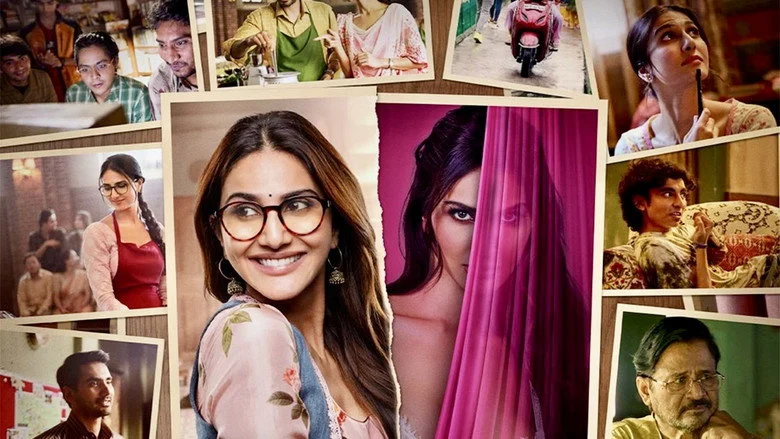
The most telling image in Sarvagunn Sampann is Vaani Kapoor in a salwar-suit and glasses, the very picture of middle-class modesty, while the world projects an entirely different identity onto her. That single frame holds more tension than the script ever manages to sustain. It is a visual thesis statement about how quickly society strips a woman of her own definition.
Kapoor’s performance carries the weight of this contradiction with visible strain. She oscillates between innocence, embarrassment, and a quiet defiance that never fully erupts. The role demands more internal conflict than broad comedy, and she handles the confusion credibly. But the film never gives her the explosive scene her character deserves.
Ishwak Singh’s Earnest Heartland Turn Feels Mismatched
Ishwak Singh plays the simple, honest, hopelessly romantic heartland boy, a notable shift from his more intense screen image. His sincerity is palpable, but it sits awkwardly against the film’s satirical ambitions. He represents the “respectable” world that misreads the protagonist, yet his character arc remains frustratingly thin.
Singh’s casting signals the film’s desire for warmth amidst its social critique. His presence softens the edges of a story that could have been sharper. In a better-written film, his romance would complicate the central conflict. Here, it merely fills space between satirical beats.
The Genre-Core Execution: Satire That Hesitates
Sarvagunn Sampann identifies itself as social satire, using mistaken identity to expose the absurdity of respectability politics. The 1990s setting is a smart choice, framing the conflict in an era when such labels carried even more weight. The premise itself is genuinely sharp: a woman judged not by who she is, but by whom she resembles. That idea alone justifies the film’s existence.
Yet the execution keeps pulling its punches. The script establishes the central misunderstanding but never pushes it into genuinely uncomfortable territory. Instead of escalating the social hypocrisy, it settles for gentle observations. The satire stays on the surface, and the film’s own ambitions remain unfulfilled. The second half reportedly loses momentum as the premise exhausts its limited variations.
What saves the film from irrelevance is its clear intent. The dialogue about identity, labels, and the “perfect woman” lands with enough sincerity to register. But intent without rigorous follow-through produces a film that feels like a strong first draft. The original idea needed more narrative ammunition to sustain its runtime.
A Supporting Ensemble Held Back by the Script’s Limitations
Raghubir Yadav and Brijendra Kala, two of Hindi cinema’s most reliable character actors, are listed in the supporting cast. Their presence signals the film’s aspiration toward grounded, authentic comedy. Both actors have built careers on elevating modest material through sheer presence. Their casting here suggests the director wanted that dependable texture.
Yet without specific scene-level moments to latch onto, they remain underutilised presences. One can only imagine what Yadav could have done with a sharper satirical set-piece. The supporting cast is a reservoir of talent the screenplay fails to draw from effectively. That is a missed opportunity the film cannot afford.
The Sharp Premise That Needed Bolder Writing
Critic coverage has been consistent on one point: this is a premise stronger than its execution. The social-satire intent is recognized, and Kapoor’s balancing act is noted, but the script reportedly does not catch up to its own ambitions. HDHub4u’s review coverage placed the film at 2.5/5, a fair assessment of a film that sparks more ideas than it resolves.
The film’s long-delayed journey to Zee5 suggests a troubled production history. Such delays often signal creative uncertainty, and that uncertainty shows in the final product. The film never fully decides whether it wants to be a warm comedy or a biting satire. It ends up being neither, landing in an uncomfortable middle zone. What remains is a well-intentioned film that respects its subject but fears its own conclusions.
For viewers who value social commentary over plot propulsion, there is enough here to warrant a curious glance. The premise engages with questions of identity and labeling that remain painfully relevant. But those expecting a tightly wound narrative will find themselves checking the runtime. The class audience and fans of identity-based comedy-drama will find something to appreciate. This is a film that understands its world but lacks the courage to fully indict it.
For more such explorations of flawed yet fascinating storytelling, browse our Hindi Drama reviews for films that wrestle with similar themes.
Sarvagunn Sampann is best watched on OTT with tempered expectations. It is a film to appreciate for its intentions, not its execution. The premise deserved a braver writer, and Kapoor deserved a script worthy of her commitment.
Sarvagunn Sampann offers a promising concept wrapped in timid storytelling, making it a 2.5/5 watch for those curious about its social commentary.
For a more assured take on identity and self-acceptance, revisit Hi review which handles similar themes with greater warmth.
If atmosphere-over-momentum storytelling intrigues you, Poovellaam Kettuppaar verdict understands the value of restraint far better.