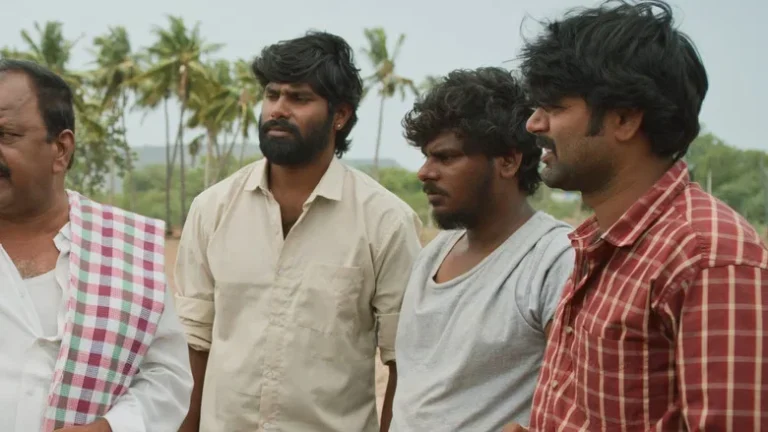
A spirited villager rallies his 1980s Andhra Pradesh community through sport to reclaim their dignity against a powerful rival. The premise is built on collective resistance, not individual heroism, a choice that immediately signals where director Buchi Babu Sana’s ambitions lie.
Peddi operates at the intersection of sports narrative and action-drama spectacle, a combination that should appeal to viewers seeking scale and social stakes. Whether the execution justifies a near-three-hour commitment remains the central question hanging over this ensemble film.
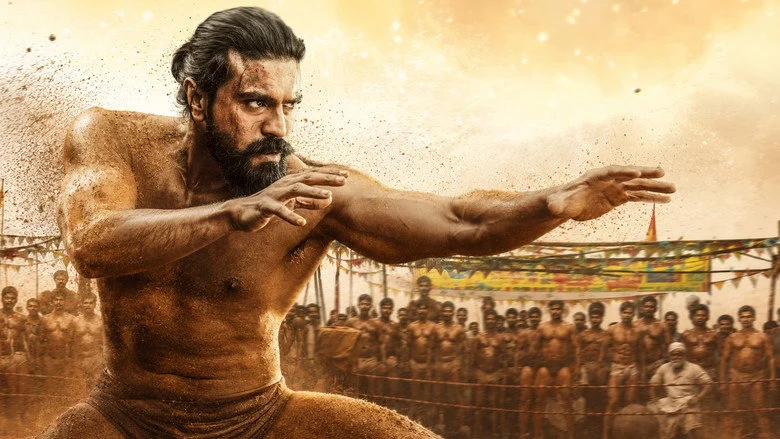
Ram Charan Anchors a Village-Scale Narrative
Ram Charan carries the film’s central arc, a lead character designed around physicality and mass-drama intensity rather than verbal complexity. The role positions him as the engine of community mobilization, a framing that aligns with his screen presence in rural-action registers. This is casting that serves clear narrative function: Charan as the embodiment of collective will, not introspective conflict.
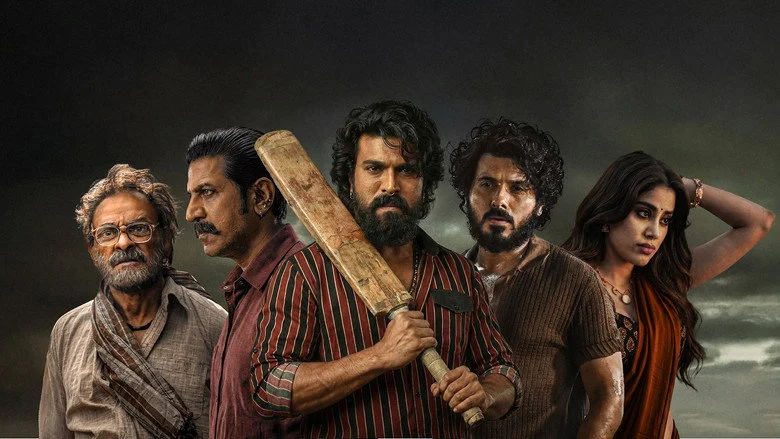
Buchi Babu Sana Builds Linear Structure, Gambles on Runtime
The director also wrote the screenplay, a choice that often protects tonal consistency but creates runtime risks. The 189-minute span suggests extended emotional and scale-driven buildup rather than efficient storytelling. A linear conflict structure, village versus rival, sport as resistance tool, works cleanly on paper; whether it sustains engagement across three hours without narrative slack is where the film’s craft reveals itself.
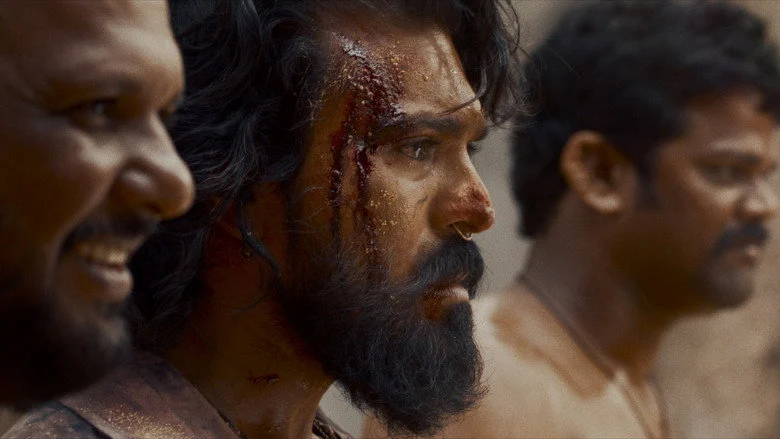
Sports as Resistance Engine in Rural 1980s Andhra Pradesh
The sports element is not framed as competition for its own sake, but as a mechanism for community mobilization against oppression. This transforms what could be a straightforward sporting underdog story into something closer to a political-action drama. The rural period setting, 1980s Andhra Pradesh, provides visible social geography where stakes feel material and collective.
Action sequences are bound to the conflict between the village and its rival force, meaning choreography and stunt geography should emerge from character relationships and territorial stakes rather than spectacle for its own sake. The question is whether Sana frames physical confrontations as extensions of communal struggle or treats them as standalone set-pieces. The trailer’s emphasis on lead-versus-rival conflict suggests the former, but confirmation requires theatrical engagement.
The ensemble cast, Ram Charan, Janhvi Kapoor, Shiva Rajkumar, Jagapathi Babu, Divyendu Sharma, and Boman Irani, indicates an attempt at broad-based narrative distribution. Sports dramas often fumble ensemble dynamics, allowing secondary characters to feel functional rather than lived. The runtime suggests Sana intends to avoid this pitfall, though structural discipline becomes even more critical when a story refuses to focus narrowly.
Those seeking comparable Telugu sports-action films should explore the broader terrain of Telugu Action reviews to understand how the grammar of rural resistance plays across recent Telugu cinema.
Jagapathi Babu Shoulders Antagonistic Weight
Jagapathi Babu carries the rival force that threatens village pride and stability, a casting that signals a heavyweight antagonist, not a functionary obstacle. His presence alone suggests the film intends serious dramatic opposition, not cartoon villainy. Whether the screenplay grants him enough dimensionality to register as a force rather than a name remains uncertain without scene-level verification.
Budget Ambition Signals Scale, Absence Signals Risk
The ₹350 crore production budget (reported on Wikipedia) indicates genuine large-scale investment, a figure that shapes expectations for visual texture and action construction. A film operating at this cost operates under box-office pressure that shapes creative choices, runtime becomes a fiscal gamble, not an artistic choice alone. Without verified pre-release critical response, audience reception becomes the only honest measure of whether that budget served the story or burdened it.
This is a film designed for mass theatrical viewing, ideally in a large-format experience that honors the rural-action staging and communal scope. Peddi asks viewers to commit nearly three hours to a sports-driven narrative about collective dignity, a premise with clear appeal for audiences seeking socially-grounded action-drama. Whether that appeal survives execution depends on pacing discipline and whether supporting characters feel like community members or narrative placeholders. The ambition is visible; the payoff awaits theatrical evidence.
Ram Charan’s command presence and a sports-resistance premise built on communal stakes should anchor this for the mass Telugu audience and cross-Indian viewers unafraid of length, provided Sana maintains narrative momentum across a runtime that invites pacing collapse. The film targets a specific viewer, one who values scale, rural authenticity, and action-drama spectacle over intimate character study, and executes that positioning with apparent conviction. Watch in theater if mass-scale Telugu action-drama appeals; skip if you prize narrative economy over emotional amplitude. Peddi is an ambitious ensemble sports-drama that justifies its scale ambition on premise alone, though execution remains a 2.5 to 3.5 out of 5 proposition depending on how Sana manages three hours of village-versus-rival resistance.
Both this film and Great Grand review prioritize ensemble-scale narrative over single-character focus, building spectacle through collective action rather than individual heroics.
Peddi’s community-resistance framing shares thematic DNA with Habeebi verdict‘s investment in cultural and social specificity as narrative anchor.