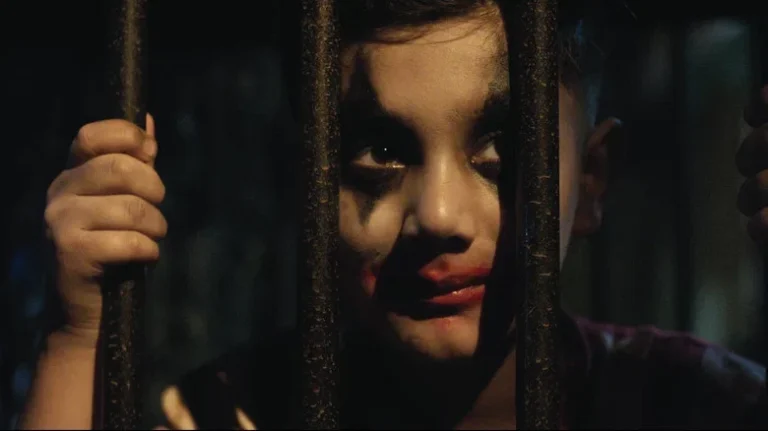
The film opens with two thieves prying open a vintage doll at the Aryanattu estate, a moment so cliché it almost dares you to roll your eyes, until the vengeful Yakshini inside makes her presence known with a swift, brutal murder. *Aroopi* doesn’t waste time building atmosphere; it throws its central monster at you before you’ve even settled into your seat, signaling a horror film more interested in immediate scares than slow dread.

Vaisakh Ravi: A Debutant Carrying Ancestral Weight
As Niranjan, the last surviving heir drawn back to the family estate, Vaisakh Ravi delivers a performance that is more sturdy than spectacular. His investigation scenes capture a man weighed down by secrets, but his emotional range in the climactic confrontation with the Yakshini shows a budding actor who understands the assignment.
His vulnerability during the final showdown, where the curse demands a personal price, lends the supernatural horror a rare, grounding gravity. For a debutant, Ravi holds the screen without wavering, even when the script asks him to do little more than react to eerie set-pieces.
Neha Chawla’s Yakshini: Menace in a Doll
Neha Chawla, known for her Bollywood presence, brings a fascinating physicality to the vengeful Yakshini, her movements snaking with an otherworldly menace that feels both ancient and immediate. Her transformation from a sealed entity to a fully unleashed terror is the film’s most effective visual trick, though the character’s motivations remain frustratingly one-note beyond revenge.
She is a strong anchor for the antagonist role, but the screenplay never gives her the dialogue or backstory to make her feel like more than a plot device. What she lacks in depth, she compensates for with an icy, menacing glare that sticks with you after the credits roll.
Genre-Core Execution: Supernatural Thrills with Familiar Beats
Director Abhilash Warrier leans hard into the vintage doll conceit, which works as a strong visual metaphor for the generational curse at the film’s heart. The scene where the Yakshini is accidentally unleashed is handled with efficient jolts, though it lacks the lingering tension that separates a good scare from a great one. The horror relies more on sudden appearances and loud cues than on atmospheric dread, which may disappoint fans of slower-burn Malayalam horror.
The investigation-driven second act, where Niranjan uncovers dark family secrets, gives the narrative a procedural rhythm that keeps it from becoming a simple monster hunt. However, the pacing feels uneven, the film spends too much time on the group of newcomers being picked off, leaving Niranjan’s personal stakes undercooked. The linear structure is serviceable, but the screenplay lacks the sharp twists that elevate supernatural thrillers.
Where *Aroopi* succeeds best is in its climactic showdown, a high-stakes collision of emotional resolution and supernatural ferocity that delivers the desired catharsis. The technical execution here, Gopi Sunder’s background score and the eerie cinematography of the Aryanattu estate, finally aligns to create a moment of genuine tension. It’s a strong finish, even if the journey to get there feels a bit too familiar.
Supporting Cast: Ensemble Without Individual Sparks
Joy Mathew provides the narrative with its only real sense of gravitas, playing a role that hints at the estate’s history without ever expanding into full exposition. Kannan Sagar and Kiran Raj, part of the ill-fated group of newcomers, are functional but utterly forgettable, they exist solely to be picked off by the curse.
Casting names like Anthony Henry and Vishnu Kanth suggests a deliberate attempt to build a recognizable ensemble, but the script gives them no defining moments. Their presence signals the film’s intent to feel like a larger, event-horror piece, yet they remain passengers in Niranjan’s story rather than players in their own right.
Audience Reception: A Quiet Debut with Mixed Signals
With no critic ratings or box office figures available in the early days of its release, the reception for *Aroopi* remains a question mark. Social media sentiment, where available, has praised Vaisakh Ravi’s debut and the effective supernatural horror of the Yakshini, but complaints are scarce, suggesting a film that hasn’t sparked any significant backlash, or much passionate enthusiasm.
The lack of any reported censorship issues or political reactions means the film lands in a neutral space, where its primary currency is its genre appeal. It is neither a breakthrough nor a disaster; it is a competent horror film that exists comfortably within the boundaries of its influences.
If you are a fan of ghost-in-a-box stories and don’t mind a script that plays it safe, *Aroopi* offers a decent evening of jump scares and supernatural lore. Watch it for Vaisakh Ravi’s earnest performance and the climactic confrontation, but manage expectations for innovation. For more standout examples of the genre, browse our collection of Malayalam Horror reviews.
Final Verdict: A Serviceable Horror with a Solid Lead
Ultimately, *Aroopi* earns a cautious recommendation for genre fans who appreciate a straightforward supernatural thriller with a strong central performance. It doesn’t reinvent the wheel, but it turns it well enough to keep you watching through to the final curse-break. Just don’t expect it to haunt you long after the credits roll. Vaisakh Ravi anchors *Aroopi* with debut conviction, but the film’s familiar beats keep it from earning more than a 2.5 out of 5.
For a deeper dive into body horror and adolescent stigma, check out our review of Alpha review.
If you prefer a performance-driven drama with a patchy screenplay, Alpha verdict might scratch that itch differently.