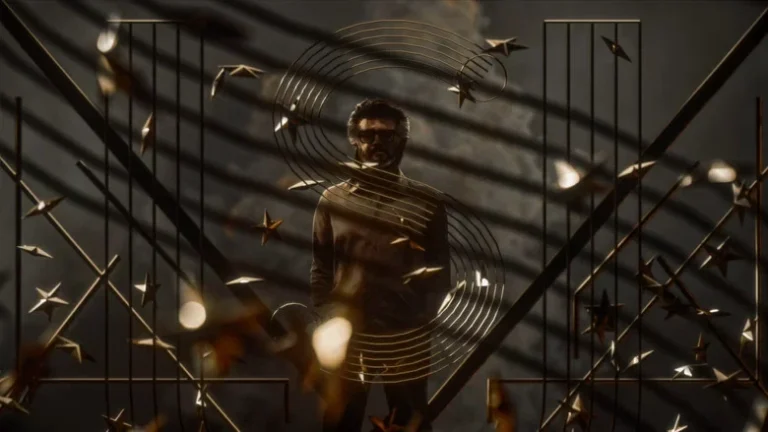
The house lights dim on a ₹500-crore question mark. Yash returns to the big screen for the first time since KGF: Chapter 2, and Geetu Mohandas hands him not one role but two, the gangster Raya and his son Ticket.
What follows is a period crime saga that mistakes scale for substance, and star wattage for storytelling.
A Director Of Intimate Spaces Drowning In A Gangster Epic
Geetu Mohandas built her reputation on bodies in close quarters and silence doing the heavy lifting. Handing her a multilingual period gangster canvas with a reported budget north of ₹500 crore is either inspired counter-casting or a fundamental mismatch, and the film’s own geometry keeps voting for the latter.
Where a peer production like Jailer 2 at least understands that its star’s stillness is the spectacle, Toxic keeps interrupting Yash with movement, sweeping crane shots, crowd choreography, dust, as if afraid the audience might notice the screenplay has nothing for him to play against.

Two Yashs, One Register, Zero Friction
The dual-role hook is the film’s entire dramatic architecture: Raya the patriarch-criminal, Ticket the inheritance. On paper it’s a clean identity engine. On screen, the distinction collapses into costume changes and a slightly different jaw angle.
Yash’s voice never really shifts between the two men. His walk stays the same. The camera frames both with the same reverent low-angle, which flattens the very contrast the premise needs. Watching him here, I kept thinking of the quieter, more physically specific work in a film like Hanuman Ansh, where performance choices were doing narrative labor that no amount of production design could replicate.

The Supporting Ensemble Exists To Fill Frames, Not Scenes
Nayanthara and Kiara Advani are both present, both given almost nothing to do but stand in proximity to Yash during ceremonial set-pieces. Their screen time is measured in glances across crowded halls, not in scenes with arcs.
The rest of the principal ensemble, Huma Qureshi, Tara Sutaria, Rukmini Vasanth, and the supporting men, function as decorative texture. Not a single one of them gets a moment where their character’s want is legible. They are cast, lit, and dismissed.
An Antagonist The Film Forgot To Write
Here is the structural wound: Toxic has no opposing force with a face. Gangster cinema lives or dies on the pressure applied to its protagonist, and this film keeps applying pressure with atmosphere instead of an adversary.
Compare that to the suffocating brother-versus-brother friction in KD – The Devil, which at least understood that the villain’s physical presence in a room is what makes the hero’s choices cost something. Toxic’s Raya is never made to sweat.
The Period Setting Is Wallpaper, Not World
Mohandas stages the film in a stylized historical past, but the era never generates rules, hierarchies, or consequences that the plot actually obeys. The production design is elaborate and inert.
Every frame is polished, and almost none of it is informative. When a film this expensive can’t tell you what year it is through behavior, the period is just a more expensive costume department.
Where The ₹500-Crore Bet Actually Lands
KVN Productions and Monster Mind Creations have staked an enormous sum on Yash’s post-KGF theatrical leverage, and the opening numbers justified the faith: a reported ₹101.10 crore India net and ₹140.75 crore worldwide on Day 1.
Then the floor gave way. By Day 6, India net sat around ₹214 crore, a strong figure in isolation, catastrophic against a reported budget above ₹500 crore. The 21% Tomatometer across 28 reviews and the sharp Monday drop tell the same story: the star delivered the audience, and the film failed to keep it.
For a market still calibrating how much of its theatrical economy should rest on single-star event releases, this is a cautionary data point in the broader conversation around contemporary Kannada actions, proof that a name can open a film and still not save it.
The Verdict: A Fairy Tale That Forgot Its Own Moral
Toxic wants to be about inheritance, what a father’s violence costs a son, what a criminal empire passes down. It never earns that theme because it never lets Raya and Ticket share a scene that isn’t choreographed like a poster.
Yash remains a genuine movie star, and the film’s opening proves his pull hasn’t faded. But a star is not a screenplay, a budget is not a story, and a dual role is not automatically a duality. Toxic is a very loud film about very little, and its ₹500-crore invoice is the only thing in it that leaves a mark.