Nelson Dilipkumar opens his sequel not with a jailbreak or a body dropping through a skylight, but with Rajinikanth bagging groceries. The image is meant to be disarming. It lands instead as the film’s thesis statement: a superstar buried under a supermarket apron, waiting for the plot to remember him.
The problem is that the plot remembers him almost immediately, and then spends two hours and forty-five minutes pretending it hasn’t.
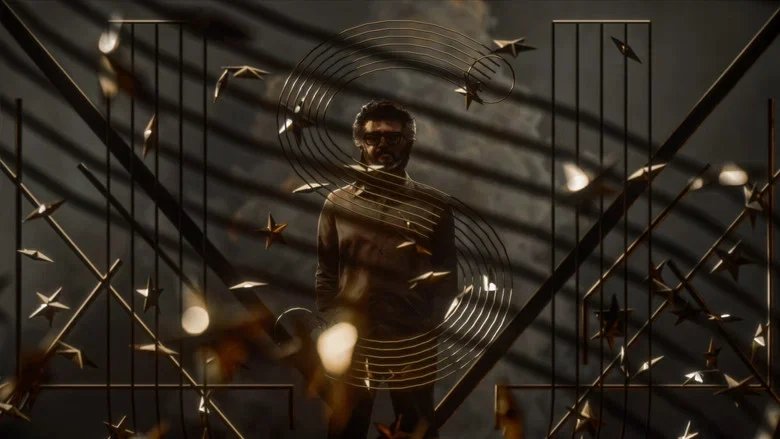
A Retired Killer Is Only Interesting Until The Killing Resumes
Muthuvel Pandian has relocated his family to a remote stretch of Tamil Nadu, working as a supermarket supervisor while his son’s widow and grandson carry the grief of Arjun’s death from the previous film. The cover is meticulous. The film is not.
Within the first act, a squabble with a municipal officer named Bhaskar and a side gig driving fruit for a shop owner named Moorthi have already exposed Muthuvel’s movements to the syndicate hunting Varman’s killer. The screenplay treats these as innocent local complications. They are actually the film’s only functioning suspense mechanism, and Nelson burns through them with alarming speed.
The sequel’s crime engine, three truckloads of ancient statues hidden by the deceased Varman, is a genuine improvement on the first film’s personal-revenge chassis. It gives the syndicate something to hunt that isn’t just a man. But the screenplay never establishes why these statues matter to Muthuvel’s past, which leaves the MacGuffin doing structural work the writing hasn’t earned.

Suraj Venjaramoodu Investigates, Rajinikanth Conceals, And Neither Gets A Real Scene Together
Suraj Venjaramoodu plays Dileep, the operational antagonist tasked with finding Varman’s killer and recovering the shipment. He is a fine actor working with a function rather than a character. His investigation proceeds through procedural beats, not psychological friction, and the film never stages a sustained confrontation between hunter and quarry until the machinery demands it.
That absence is the sequel’s central failure. A concealment thriller lives or dies on the pressure of proximity, on the audience’s awareness that the man being hunted is standing three feet from the man hunting him. Nelson stages this dynamic exactly once, in a municipal-office scene where Rajinikanth’s stillness does the work his dialogue refuses to. The rest of the runtime keeps the two men in separate films.
Rajinikanth himself is doing something more interesting than the material deserves. Watch his hands in the supermarket sequences: the way he shelves inventory with the same economy he once used to break jaws. The performance is built on delayed recognition, on the audience knowing what the other characters don’t. It’s a legitimate star-vehicle strategy, and he executes it with the precise physical discipline that has defined his late-career work.
The supporting ensemble, meanwhile, is largely ornamental. Mohanlal’s Matthew and Shiva Rajkumar’s Narasimha return as underworld allies, but the screenplay gives them entrances instead of arcs. Ramya Krishnan’s Vijaya carries the family’s grief with real weight in her few scenes, which only makes the film’s refusal to give her more to do feel like a waste of the sequel’s most grounded emotional resource.
Nelson Dilipkumar Has Made This Film Before, And The First One Was Tighter
The director’s structural instincts remain intact. He understands that a retired enforcer’s mundane cover is more tense than any underworld set piece, and he stages the domestic sequences with a patient, observational camera that refuses to underline their significance. The supermarket interiors and municipal offices feel like real spaces, not production-design approximations of them.
But the sequel’s pacing betrays its own best ideas. The first half builds its cover-life detail with genuine care, then the second half abandons that discipline for a pursuit structure that never generates the escalation it promises. The film’s reported 165-to-176-minute runtime is not the problem. The problem is that the screenplay treats the return-to-violence premise as an inevitability rather than a choice, which drains the climax of the moral weight the first film at least gestured toward.
Anirudh Ravichander’s score returns with the same aggressive synthesis of Tamil folk percussion and electronic bombast that defined the original. It works in isolation. In context, it frequently does the emotional work the screenplay hasn’t bothered to earn, cuing the audience to feel something the scene itself hasn’t built.
Where the first Jailer at least committed to its star’s late-career reinvention, this sequel hedges. It wants to be both a character study of a man unable to escape his past and a mass-action spectacle where that past is celebrated. Those two impulses cancel each other out. The film never decides which one it’s actually making.
Nelson’s earlier work, including the comparatively disciplined Hanuman Ansh, suggested a filmmaker learning to trust his audience’s patience. Here, he doesn’t. Every quiet moment is followed by a reminder that the quiet won’t last, which means the quiet never actually lands.
When A Star’s Gravitas Becomes The Film’s Only Load-Bearing Wall
Rajinikanth’s performance is the sequel’s most reliable asset and its most uncomfortable limitation. He brings a specific physical grammar to Muthuvel: the slight forward lean when listening, the way he occupies doorways as if calculating exits, the deliberate softening of his voice when speaking to his grandson. These are choices, not instincts, and they suggest an actor fully aware that he’s carrying more than the screenplay has provided.
Compare this to the controlled dual-role work S. J. Suryah delivered in Sardar 2, where the performance had to generate its own internal tension because the script refused to. Rajinikanth is doing something similar here, but the film around him is too enamored with his iconography to let him be vulnerable for more than a scene at a time.
The result is a performance that’s frequently better than the movie containing it, which is not a compliment to the movie.
The Syndicate Plot Is A Better Engine Than The Film Knows How To Drive
Varman’s death driving the investigation is a smart structural choice. It creates an antagonist who is absent but present, a ghost whose unfinished business pulls the living into conflict. Dileep’s pursuit of both the killer and the statues gives the sequel a dual objective that should generate compounding tension.
But the screenplay never clarifies why the statues matter to Muthuvel specifically, which means the climax’s stakes are institutional rather than personal. The family is in danger because the plot requires them to be, not because the story has built a credible path from the syndicate’s investigation to Muthuvel’s doorstep.
This is the difference between a thriller and a sequence of events. The former requires causality. The latter only requires momentum.
The film’s most effective sequence, a mid-film confrontation that forces Muthuvel to reveal a fraction of his capability to protect his grandson, works precisely because it’s the one moment where the screenplay connects the domestic cover to the criminal pursuit. It’s a glimpse of the movie this could have been.
Contemporary Tamil thrillers have been moving toward tighter, more psychologically grounded structures, as evidenced by films like Ananya's Call, which understand that tension is a function of proximity and duration, not scale. Jailer 2 has the ingredients for that kind of film. It just doesn’t trust them.
Sun Pictures Is Betting On A Franchise That Hasn’t Figured Out Its Own Rules
Sun Pictures has made a significant financial commitment to this sequel, and the calculus is clear: Rajinikanth’s theatrical leverage remains substantial, particularly in the Tamil market, and the first film’s success created a franchise opportunity that any studio would pursue. The reported IMAX release signals an ambition to position the film as a large-format event, which makes commercial sense for a star vehicle of this scale.
But the sequel’s structural problems raise a larger question about the sustainability of the star-driven franchise model in contemporary Tamil cinema. The first Jailer worked because it was a self-contained story with a clear emotional arc. This sequel depends so heavily on prior relationships and unresolved threads that it struggles to justify its own existence beyond the commercial logic of brand extension.
The regional remake pipeline and franchise-sequel economy have created a market where stars like Rajinikanth can still open a film on name recognition alone, especially across circuits tracking ibomma telugu movies and multilingual releases. But that leverage diminishes with each installment that prioritizes continuation over construction. Jailer 2 will likely perform well in its opening window. Whether it builds the kind of goodwill that sustains a third entry is a different question entirely.
The film’s reported ensemble, including Vijay Sethupathi, Vidya Balan, and Mithun Chakraborty in supporting roles, suggests Sun Pictures is hedging its bets by stacking recognizable faces. That strategy can work for a single release. It cannot substitute for a screenplay that knows what it’s about.
A Sequel That Confuses Continuation With Consequence
The ending, which I won’t spoil beyond noting that it resolves the statue plot and re-establishes Muthuvel’s dual identity, lands with the weight of a contractual obligation rather than a dramatic conclusion. The family is safe. The syndicate is defeated. The status quo is restored. Nothing has fundamentally changed, which means nothing has fundamentally mattered.
This is the central problem with Jailer 2. It treats its protagonist’s violent past as a resource to be deployed rather than a wound to be examined. The first film at least pretended to ask whether a man could leave his old life behind. This one answers the question before the credits roll: no, but that’s fine, because the old life is more fun anyway.
Rajinikanth deserves better than a sequel that mistakes his presence for a story. He’s giving a performance that suggests he knows it. The film around him just isn’t listening.
There’s a version of this movie where the supermarket supervisor and the syndicate investigator share more than a chase. Where the statues mean something. Where the family’s grief isn’t just backstory but engine. That version exists somewhere in the footage. It just didn’t make it to the screen.
What we’re left with is a star vehicle idling in neutral, waiting for a plot that never arrives with the urgency it needs. The Tiger is back. The question is whether anyone, including the filmmakers, knows why.