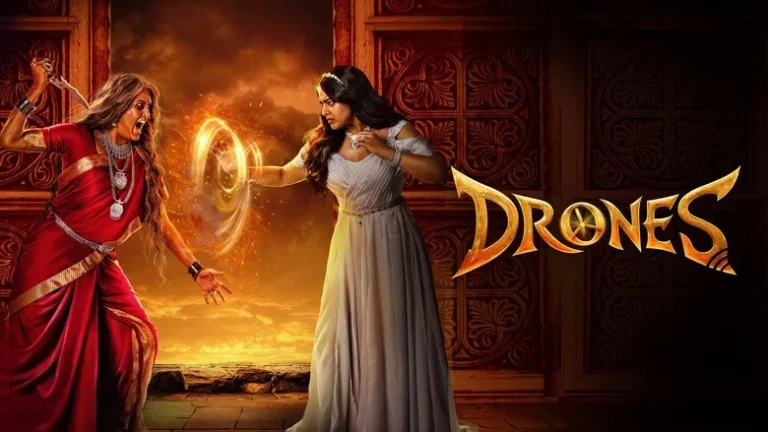
A young woman stands in her own living room, facing an intrusion that shouldn’t exist, something that breaks every rule of physics and patience. The clock is ticking, tragedy is loading, and director Gauthaam has exactly 33 minutes to make us care or lose us entirely.
That compression is both the film’s boldest asset and its most obvious risk. In an era where Tamil thrillers routinely stretch past two hours, Ananya’s Call arrives as a deliberate counter-programming statement, a short-form experiment that trusts its premise more than its padding.
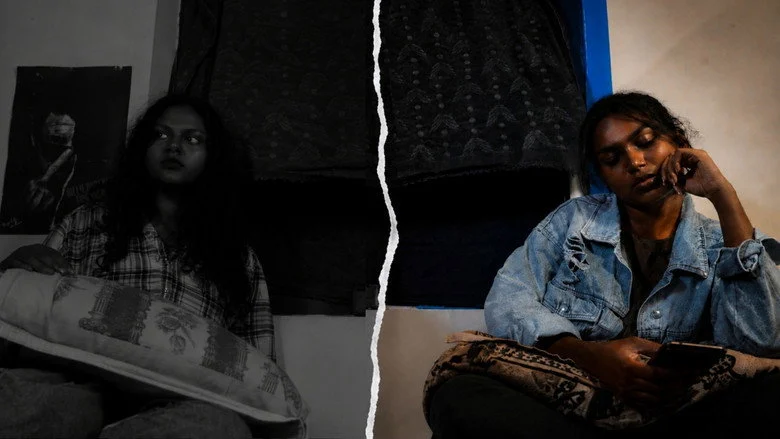
Harini Parthibanraj carries the entire weight of a one-woman crisis
Harini Parthibanraj, as Ananya Iris, is essentially the film’s engine, its fuel, and its brake system. The entire narrative hinges on her ability to sell panic without tipping into melodrama, a tightrope walk that defines whether this 33-minute ride works at all.
There is no room for a slow burn here. She must establish normalcy, register the impossible, and pivot to survival mode within what feels like real time. That’s a demanding ask for any performer, and the film’s fate rests almost entirely on her shoulders.
Gauthaam’s direction: efficient setup, but the script leaves no room to breathe
Gauthaam clearly understands the value of a confined space. A single home setting, a time-critical threat, and a protagonist who can’t just walk away, that’s classic thriller geometry, and the director respects its contours.
But the screenplay’s weakness is structural: with no subplots, no secondary locations, and no breathing room, the film must earn every second. One miscalculated beat and the whole thing collapses into a gimmick rather than a genuine tension machine.
The premise, a tragedy that defies natural laws, is intriguing on paper. Whether the execution translates that concept into actual dread is the question the film must answer in real time.
The thriller core: home invasion meets science fiction, minus the spectacle
The genre blend here is unusual, a thriller that borrows from fantasy and science fiction without ever leaving the living room. That restraint is admirable; it forces tension to come from performance and sound design rather than visual effects.
The central confrontation inside Ananya’s own home is the film’s anchor scene, the moment where the mundane and the impossible collide. It’s a setup that has worked in countless Tamil thrillers, but the short runtime means there’s no luxury of slow dread, the escalation must feel both sudden and inevitable.
The race-against-time structure is the film’s backbone. Every scene must add pressure, every line must carry information, and every silence must feel loaded. In a 33-minute format, there’s no room for filler, and that’s either a blessing or a curse depending on how sharp the writing is.
Fans of compact Tamil thrillers will find this format refreshing, for more on that front, browse our Tamil Thriller reviews.
Supporting voices: Poompavai and the voice cast build a world beyond the frame
Poompavai, as Anusiya, shares the screen with the lead, but the research tells us little about her specific moments. What’s clear is that her presence signals an attempt to ground the fantastical premise in a human relationship, a classic device for raising stakes.
The voice performances from Rinthiya and Sakthi Nivashini are an interesting choice. Casting voices for key characters (Sobiga and Navya Iris) suggests either a stylistic decision or a production constraint, either way, it creates a layer of distance that could work for a thriller about unnatural events.
Swetha M appears as Sobiga in live-action form, which creates an intriguing split, the same character rendered both visually and audibly by different performers. That duality might be intentional, but without scene-level detail, it remains a curious footnote rather than a talking point.
Audience fit: a niche experiment with a clear target
This is not a film for viewers expecting a mainstream commercial format. There’s no masala, no interval block, no star-driven spectacle, just a lean, mean premise executed in a tight window.
The film’s ideal audience is the viewer who appreciates genre discipline over runtime. If you’re the kind of person who watches a 40-minute short and wishes it were tighter, this is squarely in your lane. If you need character arcs and subplots, look elsewhere.
The absence of any controversy or political angle is itself notable, this is a film that wants to be judged purely on its craft, not its messaging. That’s a rare purity in modern Tamil cinema, where even small films often carry social commentary.
Final verdict
Ananya’s Call is a calculated gamble, a 33-minute thriller that lives or dies on its lead performance and its ability to sustain tension without a safety net. If you’re a fan of compact, high-concept Tamil experiments, this deserves a watch in a quiet room with your phone on silent.
Watch it in the regular format, preferably in one sitting, and judge it on its own terms.
For a similar exercise in restrained tension, check out Musafir Cafe review.
Gauthaam’s film is a lean, ambitious misfire that shows promise but never fully earns its own premise, a 2.5/5 for effort and compression, docked for execution gaps.
If you enjoyed this film’s genre-blending approach, you might also appreciate Souls Wind verdict.