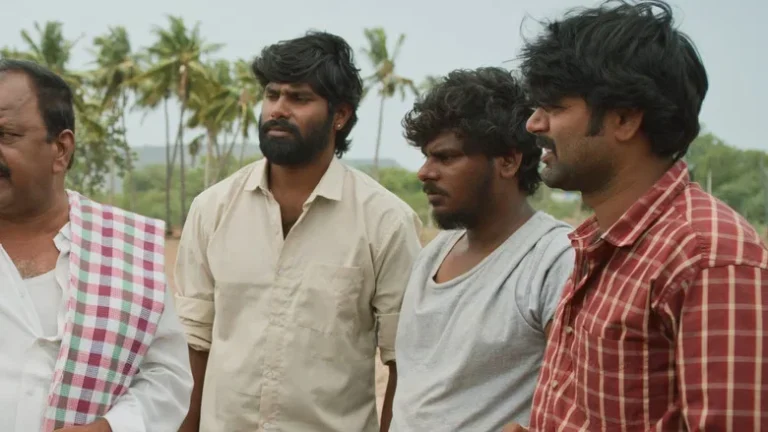
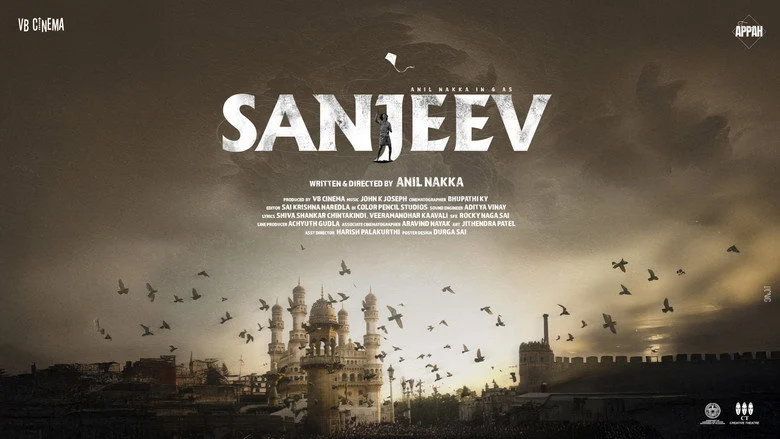
Anil Nakka doesn’t just direct Sanjeev, he stars in it, produces it, and writes it. That’s a lot of hats for a 70-minute drama about a man named Sanjeev, and the risk shows in every frame. He has no star power to hide behind, no established director’s cushion. Just a raw premise and his own willingness to be vulnerable on screen.
This is the kind of gamble that either pays off as raw authenticity or collapses into self-indulgence. Nakka’s performance carries the weight of the entire production, and for most of the runtime, he manages to hold it together.
A Director Who Refuses to Let the Camera Blink
Nakka’s direction is lean and economical, which suits the film’s brief runtime. He doesn’t waste time on establishing shots or decorative transitions, every scene moves the internal conflict forward.
But the screenplay suffers from a structural thinness that’s hard to ignore. At 70 minutes, there’s no room for subplots or breathing space, and the film feels more like an extended short than a complete feature. The lack of a clearly defined antagonist leaves the drama floating in a vacuum of internalised grief.
Drama’s Core: Carried by Silence, Tested by Repetition
Sanjeev operates in the quiet registers of Telugu drama, where grief is expressed through pauses and unspoken gestures rather than dialogue. Nakka leans heavily on his own face to communicate what words cannot, and there’s a certain bravery in that choice. The camera holds on his expressions longer than commercial cinema would dare, demanding patience from the audience.
Yet the genre’s strength, emotional restraint, becomes its weakness when the narrative doesn’t escalate. The drama circles the same emotional territory without introducing new stakes or revelations. What begins as meditative starts to feel static by the midpoint, and the lack of scene-level variation tests viewer patience.
Where the film succeeds is in its refusal to manipulate. There are no dramatic music swells or forced catharsis, just a man processing something heavy in real time. For audiences who value that kind of honesty, this will resonate deeply. For those expecting a conventional dramatic arc, it may feel underwhelming.
Veeramanohar Kavali and Harish Palakurthi: Anchors in the Margins
Veeramanohar Kavali plays Shiva, and his presence gives Nakka someone to bounce off in scenes that could otherwise become monologues. Kavali brings a grounded quality that complements Nakka’s more introspective register, creating a believable friendship dynamic.
Harish Palakurthi, playing a character named after himself, adds a layer of meta-textual curiosity. His casting suggests a deliberate blurring of fiction and reality, though the film doesn’t fully explore this angle. Laya Miryala’s Pallavi appears in limited capacity, but her scenes hint at a larger emotional world the film chooses not to open.
The Audience Question: Who Is This For?
Sanjeev isn’t a film for everyone, and it doesn’t pretend to be. It’s built for viewers who appreciate minimalist drama and actor-driven experiments over plot-heavy storytelling. The 70-minute runtime makes it an easy commitment, but that brevity is also its ceiling.
There’s no political controversy or social backlash surrounding the film, its debates are purely aesthetic. The conversation it generates is about whether Indian indie cinema can sustain feature-length narratives on mood alone, or whether it needs stronger structural scaffolding.
I found myself respecting the film more than enjoying it, which is a different kind of recommendation.
For more independent Telugu cinema that takes similar risks, browse our Telugu Drama reviews.
If you have 70 minutes and patience for slow-burn emotional work, Sanjeev is worth your time, but go in with adjusted expectations. It’s a mood piece, not a story-driven drama, and it works best when you let it wash over you rather than demand narrative momentum. Watch it alone, with full attention, and let Nakka’s face do the talking.
Sanjeev is a sincere but structurally thin debut that earns a modest 2.5 out of 5 for its raw commitment to minimalist Telugu drama.
For a sharper take on single-character emotional journeys, see how TOY GUN review handles similar terrain.
And if you’re in the mood for a romance that hides its emotional payoff until the final act, Ram Leela verdict plays the waiting game differently.