8th Street (2026): A Quiet Night’s Anatomy of Loneliness | Review
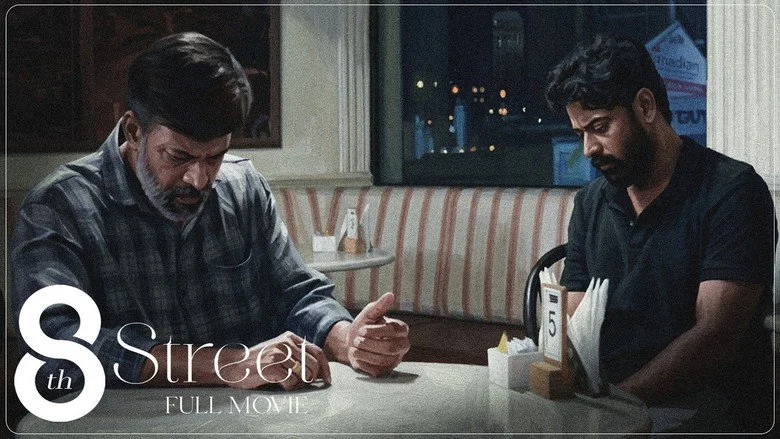
The night is the only witness. Three figures, a weary stranger, a silent old man, a tired waiter, collide in the amber glow of a late-night establishment, and Dennis Jones’s 8th Street turns that collision into a 91-minute study of what people don’t say. This is not a film that arrives with a bang; it settles in like dust, and whether that settles you or suffocates you depends entirely on your tolerance for cinema that trusts silence over speech.
Dennis Jones Crafts a Space Where Words Fail and Glances Speak
Jones, working from his own screenplay, demonstrates a confident restraint that many debut directors mistake for risk. He builds the film’s architecture on the simplest of foundations, a single location, a handful of bodies, the ticking clock of an ordinary night.
The direction’s greatest strength is its refusal to over-explain. The gradual reveal of hidden tensions arrives through a shift in posture, a held gaze, a cup that isn’t lifted. It’s precise, deliberate filmmaking that respects the audience’s intelligence, even when it risks testing their patience.
A Screenplay That Values the Pause Over the Punctuation
Structurally linear, the screenplay functions as a slow excavation rather than a narrative sprint. The opening encounter among the three characters is designed not to introduce conflict, but to introduce the weight each person carries into the room.
The flaw, however, is that this weight is sometimes too internalized. Without a single dramatic release valve, the middle section risks becoming a series of beautifully framed non-events. The tension is present, but the screenplay’s commitment to restraint occasionally reads as a fear of commitment to actual confrontation.
The Drama of Gesture: How Silence Becomes the Lead Actor
As a drama, 8th Street operates on a micro-dramatic register. The genre demands emotional texture, and Jones builds it through the smallest of brushstrokes, a waiter’s exhausted sigh, the old man’s refusal to meet a gaze, the stranger’s restless hands.
The film’s craft observation is that loneliness is not a monologue but a series of interrupted attempts at connection. The sequence structure turns a routine encounter into a reflective character study, where the drama lives in the space between one word and the next.
There is no chase, no villain, no climax in the commercial sense. The genre-core execution here is about the slow burn of recognition, the moment a character sees themselves in another’s fatigue. It’s an acquired taste, but for those who acquire it, the payoff is a haunting resonance.
The Unnamed Ensemble: Casting as a Signal of Intent
Without verified casting details, the film’s intent is still legible in its structure. A small-cast, late-night premise signals a deliberate move away from star-driven spectacle toward character-driven immersion.
These unnamed performers carry the film’s entire weight on their shoulders and their silences. The reliance on nonverbal performance is a demanding ask for any actor, and the film’s success hinges entirely on whether those unspoken moments land as authentic or merely affected.
If this measured, dialogue-light approach to storytelling appeals to you, you’ll find plenty more to explore in our Tamil Drama reviews.
Audience Fit: A Film for the Patient, Not the Restless
This is where 8th Street will find its tribe and lose everyone else. Fans of restrained character drama and mood-based storytelling will likely find the film’s meditative pace hypnotic.
Viewers expecting action-driven plotting or a broad commercial entertainer should look elsewhere immediately. The film’s mood-driven structure is its identity, and it does not apologize for it. In an era of algorithmic pacing, there is something quietly defiant about a film that asks you to sit still and watch people think.
I find myself respecting 8th Street more than I enjoyed it, which is a different kind of compliment. The film’s commitment to its singular vision is admirable, but the absence of a memorable dramatic peak leaves the experience feeling more like a sketch than a completed portrait. For those who connect with its wavelength, this is a late-night gem; for others, it’s a nap waiting to happen.
8th Street is a demanding, often rewarding experiment in cinematic minimalism that ultimately earns a reserved 3 out of 5 stars, a film to watch on a quiet night, in a regular format, when you have the patience to listen to what isn’t being said.
For a similarly uncompromising character study with a louder edge, consider Lechindi Mahila review.
If you prefer your mood pieces with a touch of animation, Moana 2026 verdict offers a different kind of visual storytelling.