System (2026): Sonakshi Sinha and Jyotika Anchor a Predictable Courtroom Drama
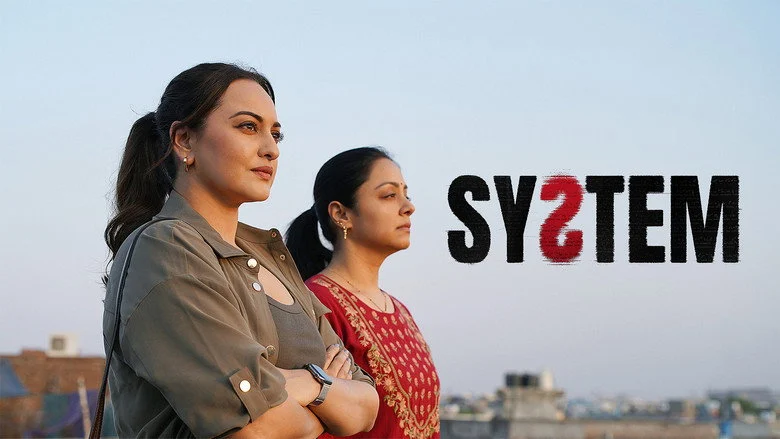
The courtroom goes quiet when Neha Rajvansh and Sarika Rawat lock eyes across the polished wood. Sonakshi Sinha, the privileged prosecutor, and Jyotika, the stenographer from humble beginnings, turn a simple legal exchange into a war of class, power, and wounded pride. It is the single most electric stretch of the film, and the reason you stay invested even when the script starts cutting corners.
Director Ashwiny Iyer Tiwari builds a grounded, serious legal drama that leans on performance over theatrics. That choice pays off in the middle, but the air leaks out of the balloon long before the final gavel drops.
Sonakshi Sinha and Jyotika Carry the Entire Weight on Their Shoulders
Sonakshi Sinha gives one of her most controlled performances as Neha. She plays privilege not as arrogance but as a quiet assumption of correctness, which makes her character’s unraveling feel earned rather than theatrical.
Jyotika matches her beat for beat. As Sarika, she brings a coiled resentment that never boils over into melodrama, and their confrontational exchanges crackle with a tension that the rest of the film struggles to replicate. The scenes built around their relationship are the film’s strongest dramatic material, and both actors understand exactly how much to give and when to hold back.
Without these two, the film would collapse entirely. They do the heavy lifting that the screenplay fails to provide.
A Serious Tone, But a Screenplay That Overextends Its Welcome
Iyer Tiwari maintains a sincere, restrained tone that suits the subject matter. The film never descends into the exaggerated courtroom antics that plague many Bollywood legal dramas, and the social commentary on institutional bias lands with some weight.
But the screenplay is cluttered with too many themes and loses focus as it progresses. The narrative is mostly linear, which works for clarity, but the writing becomes convenient, logic gaps appear in the later sections, and the reveal structure is so transparent that you see the ending coming from a mile away.
The first half is engaging because it establishes the conflict and character contrast clearly. The second half, however, loses force as the pacing slackens and the tension gives way to predictability.
Genre Execution: Performance-Driven Tension That Fizzles at the Finish
As a courtroom drama, the film uses performance interplay as its main engine of suspense. The legal and moral stakes are clear, and the institutional pressure on both women builds effectively through character conflict rather than action or spectacle. The courtroom confrontation scenes between the leads demonstrate the film’s strongest genre execution, sharp, grounded, and emotionally charged.
As a thriller, however, the mechanism weakens considerably. The mystery elements become too easy to read, and the final reveal, the point where the killer is identified, was highlighted by multiple critics as the exact moment the film’s logic and impact collapse. The ending is described as predictable and underwhelming, reducing the impact of the earlier build-up.
The film adopts a grounded courtroom tone instead of melodramatic theatrics, which is a strength. But for a courtroom thriller, it lacks sufficient dramatic escalation. The stakes feel real, yet the climax never delivers the punch the setup promises. The result is a film that works as a character study but fails as a thriller.
Supporting Cast and the Missing Antagonist
The supporting legal and institutional characters are used primarily to reinforce the pressures of the courtroom environment. They receive limited emphasis compared with the two leads, which is both a blessing and a curse, it keeps the focus on Sonakshi and Jyotika, but it also leaves the world around them feeling thin.
Notably, there is no clearly defined villain in the film. The opposing force is framed as the system itself, institutional power and bias, rather than a single antagonist. This is a bold choice that aligns with the film’s social commentary, but it also means there is no focal point for the audience’s frustration. The system is an abstract enemy, and abstract enemies rarely generate the visceral tension a thriller needs.
Times of India gave the film a 3.0/5 rating, noting that while it may not be flawless, it succeeds in presenting a socially relevant story with sincerity and strong performances. That assessment feels fair, though I would argue the sincerity sometimes masks the structural weaknesses.
One publication wrote that the film “loses its edge when its loops become too easy to read, ” and another bluntly called it “a system rigged against storytelling.” These critiques capture the central problem: the film’s ambitions exceed its execution.
If you are a class audience or a fan of courtroom dramas with social relevance, this will likely resonate with you. If you are expecting a fast, high-drama commercial thriller, you will be disappointed by the measured pacing and underwhelming climax.
For those who appreciate performance-driven legal dramas, there is much to admire here. For those seeking genuine thriller tension, the film falls short. Watch it on OTT or in a regular viewing setting, this is not a big-screen spectacle, and it knows it. Hindi Thriller reviews with this level of performance commitment are rare enough to warrant a look.
Sonakshi Sinha and Jyotika deliver performances that deserve a sharper script. The film is a watch for their sake, but do not expect the mystery to surprise you, it will not. System earns a modest 2.5 out of 5 from me, a film that understands its themes better than it understands its genre.
For a more gripping take on institutional failure, Ugly Story review explores similar themes with a darker edge.
And if you want to see how a tense setup can still stumble, Paavakoothu verdict offers a comparable case of uneven execution.