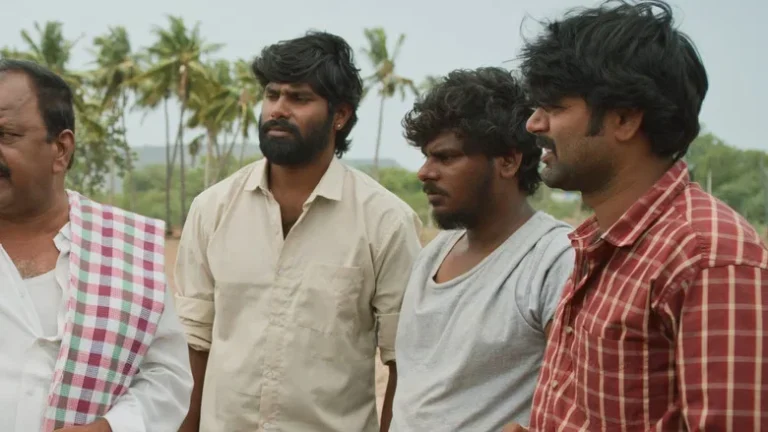
The courtroom is silent. A young athlete, Ramraj, stands across from a row of stone-faced officials, his voice cracking not from fear but from the weight of evidence he is about to lay bare. This single scene from Angikaaram announces a debut that does not aim for safe applause, it aims for the jugular of a broken system.
Director Thenpathiyan builds his film on a risky premise: an athlete’s legal battle against institutional rot. The first half moves with the coiled tension of a sports drama that refuses to stay on the field. Then the court doors swing open, and the film stakes its entire credibility on courtroom confrontation rather than athletic spectacle. That gamble does not fully pay off, but the fact that it was taken at all makes Angikaaram an outlier in mainstream Tamil cinema.
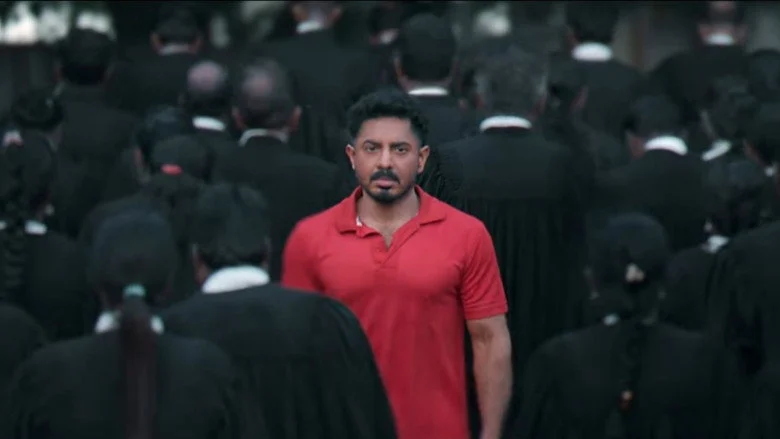
Kotapadi J Rajesh: A Performance Built on Silence and Silence-Breaking
Kotapadi J Rajesh delivers his debut with the kind of controlled fury that suggests he understands restraint is more powerful than shouting. In the corridor confrontation with sports officials, he barely raises his voice, yet his body language trembles with the accumulated fatigue of every denial he has faced.
His emotional range finds its sharpest edge in the final verdict scene. Standing to hear judgment, Rajesh makes Ramraj’s face a battlefield: hope, exhaustion, and a quiet rage that refuses to dissolve into relief. It is a performance that earns its applause without begging for it.
Direction and Screenplay: Sharp Dialogue, Blunt Edges
Thenpathiyan uses dialogue as a weapon of clarity. Lines like “Recognition comes not from power, but from justice” land because they are placed in moments where the audience has seen the cost of that belief. The courtroom writing is incisive, holding institutional failure accountable without slipping into sermon.
Yet the screenplay loses nerve in the second half. Pacing slackens as some supporting character arcs drift without resolution, and the antagonist, systemic corruption, remains an abstraction rather than a face. A film that argues so forcefully against vague power structures needed a villain with sharper teeth.
Executing the Sports-Courtroom Hybrid: Three Movements
The sports-drama engine runs on Ramraj’s first public confrontation with the officials. Thenpathiyan shoots it like an athlete’s final sprint, tight frames, shallow focus on faces, no music. The tension is purely situational, and it works because we understand the political stakes before a single legal term is spoken.
The courtroom testimony sequence operates as the film’s emotional and structural fulcrum. Evidence of corruption is laid out not through flashy montages but through patient, scripted revelation. The background score swells only after the silence has done its work, a restraint most courtroom dramas forget exists.
The final verdict scene closes the loop with earned catharsis. Ramraj’s recognition is not treated as victory lap; it is framed as the bare minimum of justice. That refusal to inflate the triumph into melodrama is where Angikaaram distinguishes itself from safer sports films. The genre execution is uneven but never dishonest.
Supporting Cast: Anchors in Uneven Waters
Viji Venkatesh appears in pivotal emotional scenes as the supporting anchor. His presence carries the weight of Ramraj’s personal cost, there is a moment mid-courtroom where he simply places a hand on Ramraj’s shoulder, and the film breathes through that small gesture.
Mansoor Ali Khan delivers an impactful performance in the court sequences, his controlled cadence lending authority to procedural moments that could have felt mechanical. Rangaraj Pandey and Vasundhara Kashyap fill roles that signal institutional opposition, though their characters remain sketched rather than fully drawn. Their casting suggests the film’s intent to surround Ramraj with faces of power, even if the script does not give them the space to become more than that.
Audience Reception: The Second-Half Debate
With an IMDb rating of 7.4/10 and a BookMyShow audience score of 3.8/5, Angikaaram clearly connects with viewers who value narrative conviction over pacing consistency. Social media sentiment sits at 78% positive, with praise concentrated on the authentic depiction of sports politics and Rajesh’s debut.
The recurring complaint, slower second half and an antagonist without identity, mirrors critical feedback from Filmibeat, which rated the film 7.2/10. The audience is willing to forgive structural flaws because the core argument feels personal rather manufactured. That goodwill matters more than pacing polish for a film this ambitious.
For those who appreciate films that risk more than they accomplish, Tamil Drama reviews with similar courtroom framing offer interesting comparisons in tonal ambition.
Watch or Skip?
See Angikaaram if you care about films that treat systemic corruption as a dramatic subject rather than a backdrop. The second half demands patience, but the courtroom heavyweight scenes and Rajesh’s coiled debut performance make the investment worthwhile. A regular theater screen serves this film well, the close-up work in the court earns the big screen.
Angikaaram is a debut that reaches for more than it grabs, but the reach itself deserves a solid 3 out of 5.
For a similar study in restrained lead performances, Heartin review how limited runtime can still capture emotional peaks.
Thenpathiyan’s risk-taking directs attention toward Suitcased verdict that shares this film’s tension between ambition and execution.