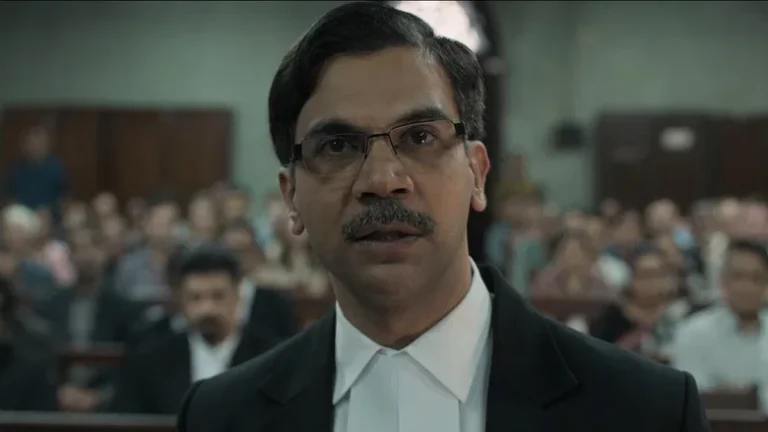
Manoj Bajpayee has spent three decades perfecting the art of the compromised man, and Gajab Raat hands him another specimen worth dissecting.
Ritesh Shah’s directorial debut strands a corrupt Delhi cop in a single night of escalating rot, and for roughly two hours, the film’s refusal to moralize becomes its most dangerous asset.
A Corrupt Cop Is a Better Engine Than a Righteous One
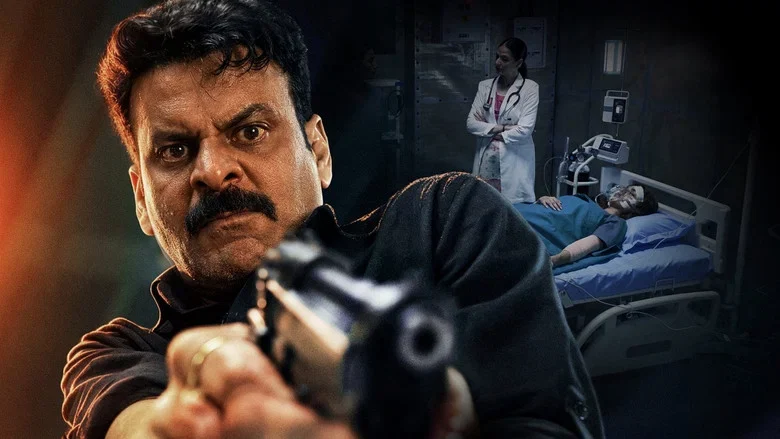
The film opens with Ajay Dikshit (Bajpayee) already deep in the grift, a police officer who treats his badge as a revenue stream and his night shift as a ledger.
When a severely injured young woman is thrown from a moving car into his path, his first instinct isn’t rescue, it’s calculation, a flicker of profit before the panic sets in.
That opening gambit is the film’s smartest structural gamble, because it denies us the comfort of a hero worth rooting for and forces us to follow a man we’d normally boo.
The Conspiracy Expands, and So Does the Pressure
Shah and co-writer Neeraj Pandey build their engine on a simple escalation: what begins as a localized assault spirals into a tangle of hidden agendas and institutional rot.
Ajay’s investigation is driven not by duty but by self-preservation, and that distinction keeps every scene humming with a queasy, self-serving energy.
The one-night Delhi framework compresses the timeline beautifully, turning every conversation into a countdown and every alley into a potential trap.
What the screenplay resists is the kinetic sensationalism that overtook Kalpana Aur Yatharth, opting instead for a deliberate, suffocating dread that never quite releases its grip.

Bajpayee’s Stillness Is the Film’s Sharpest Weapon
Watch Bajpayee in the moments after the woman lands on the pavement, the way his eyes dart between her body and the street, cataloguing exits before injuries.
His performance is built on micro-calculations: a jaw that tightens when a superior asks questions, a voice that drops half an octave when he’s lying to someone who might believe him.
The restrained physical exhaustion he brings to the later interrogations recalls the psychological weight of his turn in Last Man in Tower, where silence carried more menace than any raised voice.
Divya Dutta registers in her scenes with a watchful, withholding presence, though the screenplay gives her character too little room to become a genuine counterforce.
Shah’s Direction Favors Claustrophobia Over Spectacle
Shah, better known as a writer, directs like a man who trusts his actors more than his camera, and that restraint mostly serves the material.
The film’s visual grammar leans on tight framing and available light, so that Delhi at night becomes a series of narrow corridors and half-lit faces rather than a postcard.
Where the direction falters is in the conspiracy’s upper reaches, where the film’s diffuse antagonist, a shadowy network rather than a named villain, starts to feel less like a deliberate choice and more like an evasion.
Just as he demonstrated a tighter spatial discipline in Tu Hai Meri Kiran, Shah strips away decorative camera moves here to prioritize raw psychological friction, though he occasionally mistakes opacity for complexity.
A Supporting Cast That Never Quite Becomes a Chorus
Nushrratt Bharuccha and Akshay Oberoi appear in the film’s orbit, but their characters never accrue enough texture to register as more than plot-adjacent silhouettes.
That isn’t a knock on the performers so much as a structural gap: the conspiracy needs faces to feel real, and the film keeps them at arm’s length.
The Box-Office Math for a Mid-Budget Delhi Noir
Produced without the muscle of a major studio banner, Gajab Raat arrives in a market that has grown increasingly hostile to mid-budget Hindi thrillers unless they carry a recognizable hook.
Bajpayee remains one of the few actors who can open a film on the strength of his name alone, but his theatrical leverage has always been more critical than commercial.
The film’s one-night premise and compressed scale make it a natural fit for the streaming ecosystem, and its reported Netflix window suggests the producers already understand where the real audience lives.
This patient character study signals a welcome tonal maturity across contemporary hindi thrillers, proving that tension thrives without manufactured plot theatrics, even if the box office may not reward that patience.
The Verdict: A Thriller That Trusts Its Actor More Than Its Plot
Gajab Raat doesn’t resolve so much as it exhales, leaving Ajay in a moral fog that the film refuses to clear for him.
That ambiguity is the point, and it’s also the limitation: a conspiracy thriller needs a final shape, and Shah’s film is more interested in the texture of corruption than the architecture of its payoff.
What lingers is Bajpayee, a man whose stillness has never felt so quietly damning, and a film that understands, better than most, that the most dangerous thing in the room is a cop who’s finally stopped calculating.