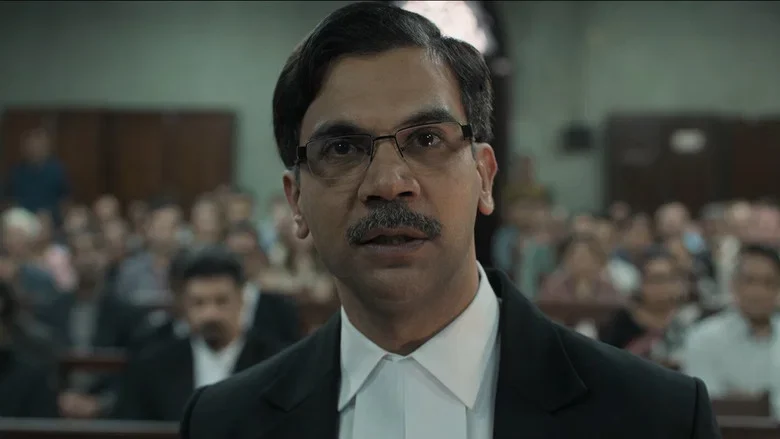
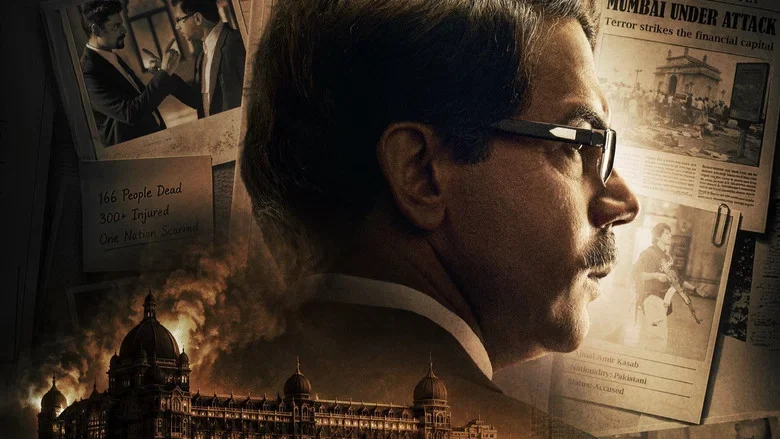
Avinash Arun opens on the smoked shell of the Taj, then cuts straight to a man in a courtroom who will spend two hours and twenty-one minutes refusing to wave his hands. Rajkummar Rao plays Ujjwal Nikam as a prosecutor who treats grief as a filing problem, every emotional impulse in the room has to be converted into something a judge will accept.
The Film Begins Where the Thriller Usually Ends
Most 26/11 retellings burn their fuel on the siege. Prahaar skips past the fire and plants itself in the paperwork: the capture, the remand, the decision to file one consolidated chargesheet instead of splitting the case into fragments that could be picked apart separately.
That single procedural choice is the screenplay’s smartest engine. It turns the film into a story about sequencing, what goes first, what survives cross-examination, what a defence lawyer can pull loose if you hand him a seam.
The problem is that this strategy also strips the first act of surprise. We know the verdict. We know the man. So the tension has to come entirely from the texture of the work, and for a while, it does.
When the Villain Denies Everything, Suspense Has Nowhere to Stand
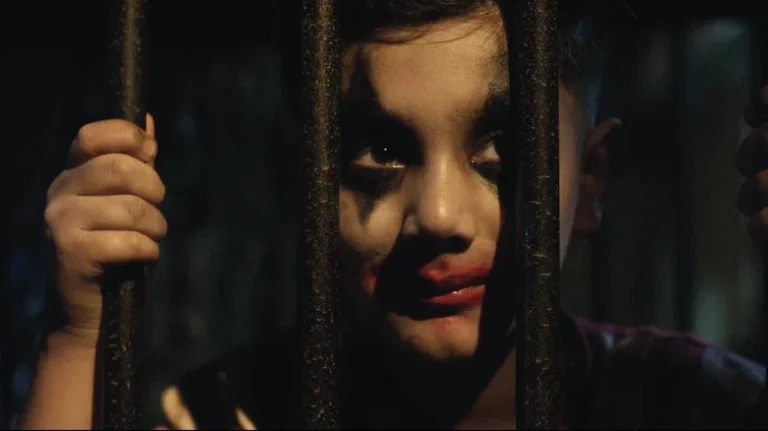
Lalit Prabhakar plays Ajmal Kasab without a single flourish of movie-villain grandeur. He sits slightly slumped, answers questions a beat late, and changes his account of his own name with the flat affect of a man testing which lie holds.
It’s a genuinely unsettling choice, and it also quietly strangles the second act. A defendant who denies everything cannot be dramatically cornered. He can only be outlasted.
So the middle stretch becomes a war of attrition between Nikam’s chain of evidence and Qureshi’s insistence that a chain is only as strong as its weakest clerk. Sikandar Kher gives the defence lawyer a low, unshowy gravity; he never raises his voice, which makes him a more credible obstacle than any shouting antagonist would be.
The screenplay resists the kinetic sensationalism that overtook Hanuman Ansh, opting instead for a deliberate, suffocating dread built out of objections and adjournments.
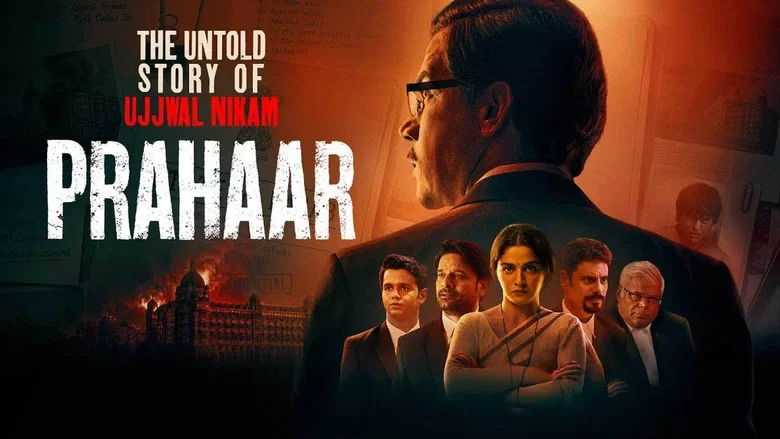
Rao’s Best Work Is in What He Refuses to Do
There is a moment where Kasab offers yet another revised version of the night, and the camera holds on Rao’s face for what feels like four full seconds. He doesn’t react. He writes. That stillness, jaw set, pen moving, eyes down, is the performance.
His authority is entirely verbal and postural. He stands at the podium with his weight evenly distributed, never leaning in, never pointing. When he finally does raise his voice, it lands like a door slamming in a library.
The restraint has a cost. His accent drifts back toward his own familiar cadence in a handful of scenes, and once you hear it, the illusion of a consistent man cracks at the edges. The psychological weight he carried in DC was built on interior collapse; here he’s playing a man who has decided interiority is a liability, and that decision is legible in every frame even when the voice isn’t.
The Personal Life Track Is a Room With No Furniture In It
Wamiqa Gabbi is given perhaps eleven minutes of screen time and roughly four lines that carry any emotional weight. She sits at a dining table, she waits by a phone, she looks at a door. That’s the arc.
It’s not her failure. She plays the quiet with real precision, a half-smile held a moment too long, hands folded around a cup she never drinks from. But the screenplay never gives her a scene that exists for her rather than for him.
Jaideep Ahlawat, by contrast, gets one speech as the Pakistani lawyer Nazzar and makes it count, threading a Sahir Ludhianvi line through a legal objection so that the rhetoric lands harder than the statute.
The imbalance is structural. When your emotional counterweight is a woman waiting at home and your intellectual counterweight is a man quoting Urdu poetry in open court, the film has already told you which one it finds interesting.
Avinash Arun Keeps the Camera Still and Lets the Words Move
The direction is disciplined to the point of austerity. Long lenses, shallow depth, faces held in medium close-up while the background blurs into institutional grey, wood panelling, tube light, the backs of heads in the gallery.
There’s almost no score during the cross-examinations. Silence does the work. When music finally arrives, it arrives late and quietly, as if the film is embarrassed to need it.
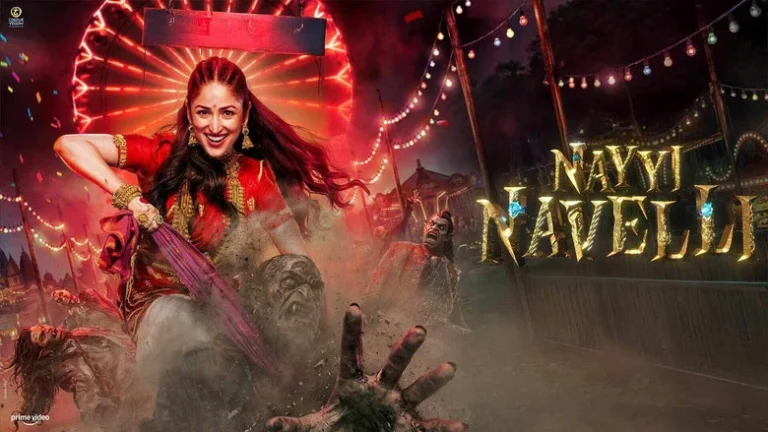
What’s missing is a visual idea about power. The courtroom is shot flatly, from eye level, over and over. Just as he demonstrated a tighter spatial discipline in Nayyi Navelli, the filmmaker strips away decorative camera moves here to prioritize raw psychological friction, but friction needs a shape, and the frame never quite finds one.
Maddock Is Betting Its Prestige Slate on a Verdict Everyone Already Knows
Dinesh Vijan’s Maddock Films has built its recent identity on horror-comedy franchises and mid-budget crowd-pleasers. Prahaar is a deliberate pivot toward prestige procedural, a film designed to win awards-season conversation rather than opening-weekend frenzy.
That’s a real financial gamble. The 26/11 trial is public record, the outcome is not in question, and the film carries an age restriction that trims the family audience. Maddock is essentially asking exhibitors to trust that craft and performance can substitute for suspense.
For Rao, the calculation is different. He has spent years alternating between comic leads and character turns, and this is his clearest bid for the serious-actor column. Whether it converts depends less on his work, which is largely there, than on whether audiences still show up for the remake-adjacent, based-on-truth legal drama in a market that has quietly moved toward louder things.
The wider shift is visible across contemporary Hindi dramas, where procedural patience is increasingly a niche taste rather than a default expectation.
The Verdict Is Guilty; the Film’s Ambition Is the Open Question
Prahaar ends where it must, with a conviction that feels less like triumph than like exhaustion, a system grinding forward until the answer becomes unavoidable. Nikam doesn’t celebrate. He packs his files.
That final image is the film’s real argument: justice as maintenance work, performed by people who will never be thanked for it. It’s a defensible thesis, and an unglamorous one.
What lingers isn’t the verdict or the rhetoric. It’s the sound of a pen moving across paper while a man who killed hundreds watches from the dock, and the prosecutor refusing to look up.