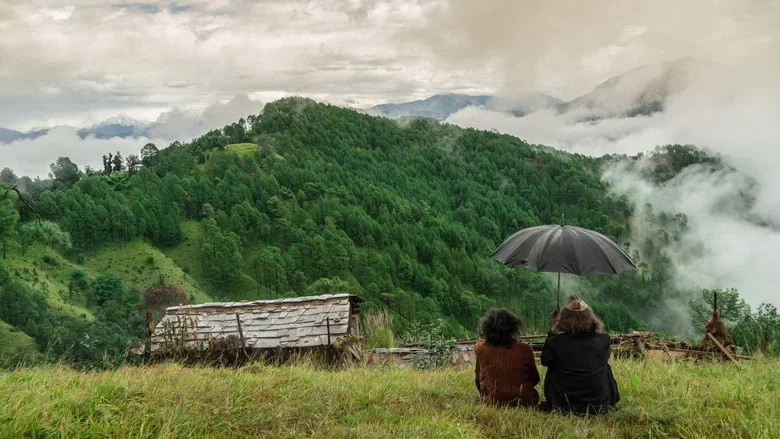
Vinod Kapri opens on a precipice, and the wind does most of the talking. An old goat herder named Padam has walked his ailing wife to the edge of a Kumaon ridge and asked her, without ceremony, to jump with him.
She refuses. That refusal is the entire film in miniature, two people who love each other reaching opposite conclusions from the same pile of evidence.
When a Death Wish Is Just Arithmetic, Not Despair
The most quietly radical thing about Pyre is how it stages Padam’s suicidal logic. There is no weeping, no trembling speech, no violins swelling beneath him.
Padam Singh Kapri, a first-time performer playing a version of himself, delivers the proposal the way a man discusses crop rotation, as a practical conclusion arrived at after long deliberation. His face barely moves. The mountain does the emoting.
This is where the screenplay earns its keep. Illness, distance, and the absence of a son who left for Mumbai nearly three decades ago are not stacked as separate miseries; they compound into a single arithmetic problem that Padam cannot solve any other way.
The Goats Are the Only Currency Left in the Village
When Tulsi’s health buckles, Padam does not beg or borrow. He trades his goats, his livelihood, his daily companions, his last liquid asset, for medical treatment.
The transaction is filmed without a single close-up of a tearful face. The weight of it sits entirely in the shrinking herd and the walk downhill, and it lands harder than any monologue could.
Kapri’s direction keeps faith with that restraint throughout. Just as he demonstrated a tighter spatial discipline in #Cult, he strips away decorative camera moves here to prioritize raw psychological friction over visual comfort.
The village empties around the couple in increments, a shuttered house, a neighbour’s departure, a road with fewer footsteps. Kapri registers depopulation as a physical condition rather than a talking point.
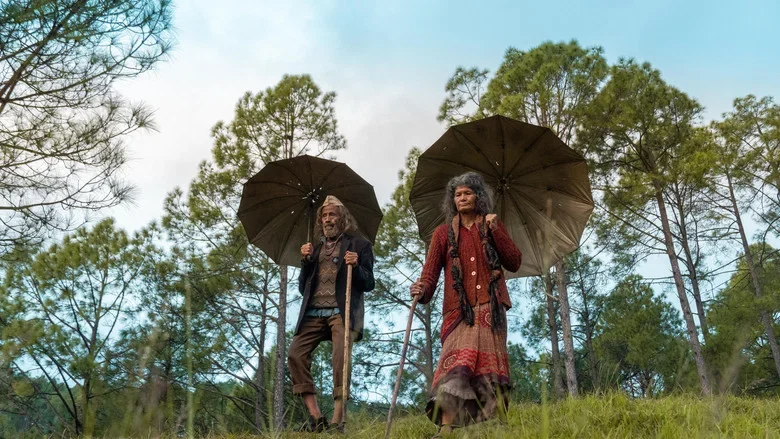
Hira Devi Refuses to Be a Symbol of Suffering
Hira Devi’s Tulsi is the film’s spine, and the performance resists every temptation toward saintly endurance. She argues back. She clutches at life with an irritation that reads as stubbornness rather than nobility.
Watch how she moves through her own home: slower each scene, but never passive, always calculating whether the next step is worth the pain it will cost. The resistance in her body is the film’s real suspense.
The chemistry between the two leads is not romantic in any conventional sense. Affection surfaces in shared routines, a meal, a blanket, a hand offered without comment, and the film trusts you to notice.
The restrained physical exhaustion Kapri brings to the goat-trading sequence recalls the psychological weight carried in Meethe Mein Kya Hai, though here it is worn by a body that has genuinely labored for decades.
Then the Postman Arrives, and the Film Changes Temperature
A letter arrives announcing that the absent son will return within weeks. The shift is immediate and almost imperceptible: backs straighten, chores acquire purpose, and the couple begins tidying a house that had stopped expecting visitors.
It is the screenplay’s smartest pivot, hope delivered through an ordinary object rather than a plot twist. The film resists the kinetic sensationalism that overtook Doosra, opting instead for a deliberate, suffocating dread about whether that hope can survive contact with reality.
Here the editing begins to betray the material. The waiting stretches, and stretches, and the observational mode that felt patient in the first hour starts to feel like a refusal to commit.
Kapri’s camera holds on empty terrain a beat past revelation, and the repetition of routine, fetch water, tend goats, sit, accumulates without always deepening. Slow cinema earns its tempo through variation; this middle passage mistakes duration for texture.
The Supporting Village Exists Mostly as Absence
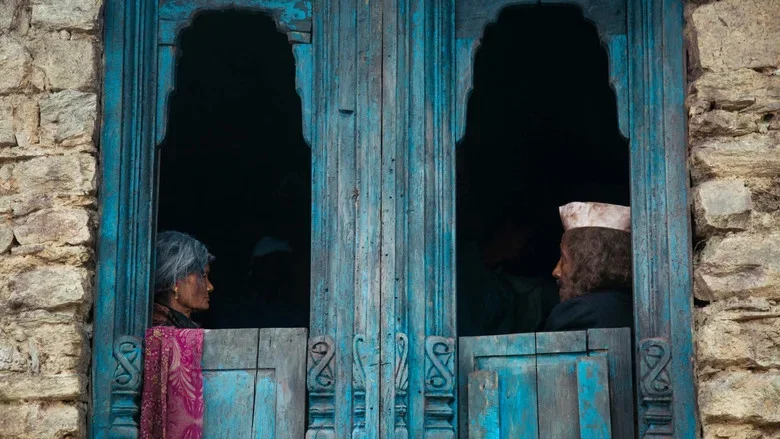
Sadab Khan’s Bishan and Subhash Chandra’s Laxman register as brief points of human contact in an otherwise depopulated landscape, but the screenplay gives them little to do beyond arriving and leaving.
That thinness is partly the point, the village’s social fabric has already unraveled, yet it also leaves the film leaning almost entirely on two faces and one mountain.
Some credit belongs to the ensemble texture, and the film’s portrait of aging in an emptying Uttarakhand settlement signals a welcome tonal maturity across contemporary Hindi dramas, even when the execution wobbles.
The Terrain Is the Antagonist, and It Never Blinks
There is no villain here, and the film knows it. The opposition is altitude, distance, and the brutal fact that medical help lies hours downhill from a house with no young legs left in it.
The cinematography treats the Himalayan scale as a barrier rather than a postcard, two small figures pinned against exposed rock, the settlement behind them visibly thinning out.
Music is used sparingly and soulfully, though the score occasionally reaches for emotion the images have already delivered more honestly. When the film trusts silence, it is formidable.
The Balance Sheet Behind a Mountain Movie
This is the kind of release that tests a distributor’s nerve: no star wattage, no franchise scaffolding, no obvious youth-quadrant hook. The theatrical math is unforgiving for a film whose pleasures are cumulative rather than immediate.
Its commercial life will depend on word of mouth among older, urban, festival-attuned audiences and on a swift, respectful OTT afterlife where its slow rhythm can be met on the viewer’s own clock.
What it does prove is that non-professional performers can carry a theatrical release without a single concession to star presentation, a data point the industry should be studying closely.
The Fire We Light for Ourselves
The title finally clarifies itself in the film’s closing movement: the pyre is not just the death Padam fears, but the terror of dying without anyone to light it. The son’s promised return collides with mortality, and the film refuses to pretend that reunion repairs three decades of silence.
What remains is the couple themselves, two people who chose, against the mountain’s arithmetic, to keep each other alive one more morning. Pyre is uneven, occasionally too pleased with its own patience, and carried by two performances of startling unvarnished truth.
It will frustrate anyone who needs a plot to move. It will stay with anyone who has watched an old house grow quiet, and understood that the quiet was the story all along.