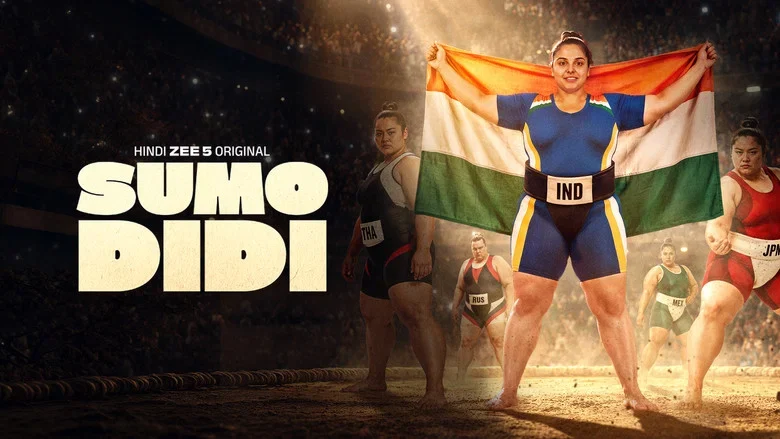
Shriyam Bhagnani steps onto the dohyō in the first ninety seconds of Sumo Didi, wins a bout in Taiwan, and the film immediately rewinds nine months to explain how a Kolkata girl got there.
That rewind is the whole architecture, and, increasingly, the whole problem.

A Cold Open That Gives Away The Ending, Then Asks Us To Care Anyway
Jayant Rohatgi opens on an international victory and then spends two hours walking backwards to it. The structural gamble is legible: by front-loading the result, the film promises that the journey, not the destination, carries the weight.
But the Taiwan bout is shot with a flat, functional urgency that never quite sells the stakes of the sport itself. We are told this matters; the ring never makes us feel it.
Compare the spatial discipline on display in Gajab Raat, where confinement generates pressure through framing alone, and Rohatgi’s competition sequences look curiously airless by contrast.
The Bitter-Gourd Mother And The Father Who Redirects Rage
The film’s real engine is domestic, not athletic. Sudha, played by Anubha Fatehpuriya with a tight, anxious mouth and a kitchen full of corrective juices, treats her daughter’s body as a marriage problem to be solved.
Fatehpuriya makes the nagging concrete: the yoga mat unrolled without asking, the liposuction suggestion delivered over a chopping board, the daily bitterness of a mother who genuinely believes she is helping.
Nitesh Pandey’s Rajendra is the counterweight, and his best scene is a quiet act of translation, when Hetal strikes a neighbour who insults her, he channels the fury into judo training rather than punishment.
It is the screenplay’s cleanest piece of psychology, and the film never quite tops it.
When The Body Stops Being A Liability And Becomes A Tool
The central idea is genuinely strong: the same frame ridiculed at a school gate becomes an athletic asset inside a sumo ring. Nikhil Sachan’s script ties PCOD, body shaming and arranged-marriage pressure into a single knot rather than treating them as separate episodes.
That integration is more sophisticated than most sports biopics attempt, and it gives Bhagnani something to play beyond determination.
Her Hetal is already a disciplined judo competitor before sumo arrives, the film wisely shows skill transfer rather than instant transformation. Watch her footwork in the early judo drills: low centre, patient weight shifts, a body learning to trust itself.
The performance foil is instructive. Where the obsession-driven protagonist of Tu Hai Meri Kiran burns through the frame, Bhagnani works in a lower, more withholding register, jaw set, eyes dropping before they lift.
The Stillness That Almost Manufactures Pressure
Rohatgi’s best instincts are reactive. He keeps the camera close during humiliation and pulls back during training, letting the ring’s geometry do the talking. Domestic interiors are lit warm and cramped; the training floor is cooler, flatter, more clinical.
That visual contrast, marriage-and-appearance spaces versus functional athletic space, is the film’s smartest unspoken argument.
What’s missing is escalation. The middle stretch drifts between low phases and recovery without building match-to-match momentum, and Chaitanya Sharma’s physiotherapist Akshat, though warm and useful, functions mostly as a sounding board rather than a dramatic force.
The supporting relatives blur into a supportive mass; the film never gives them a distinct position in the argument.
No Villain, Which Is Both The Point And The Excuse
Sumo Didi refuses a conventional antagonist, distributing opposition across ridicule, infrastructure gaps and Hetal’s own internalised shame. That choice is thematically honest, the enemy is a social reflex, not a person.
But it also removes the pressure valve that forces a sports drama to sharpen its conflicts. Without a face to push against, the film’s middle act settles into familiar inspirational beats.
The courtroom discipline of Prahaar shows how procedural constraint can generate friction; here, the constraint is diffuse, and the drama softens accordingly.
By the time the Taiwan match returns, we are watching a known result being reached by an over-familiar route.
Zee5 Gets A Prestige Title, Not A Crowd-Puller
This is a streaming original, and the commercial logic reflects it: a socially engaged, women-led sports biography is a programming asset for Zee5’s slate rather than a theatrical bet.
There is no exhibition arithmetic to audit here, no opening-day net, no franchise lifecycle to stress-test. What’s at stake is platform positioning, and on that measure the film delivers a respectable, awards-adjacent title with a genuine physical transformation at its centre.
Bhagnani’s commitment is the marketing hook, and it is a legitimate one. Whether it converts into the kind of sustained buzz that drives subscriptions is a different question, and one this restrained, soft-edged film may not answer loudly.
The broader appetite for grounded, socially specific drama continues to mature across contemporary hindi dramas, and Sumo Didi fits that trend comfortably without defining it.
The Victory We Already Saw, And What It Costs
The film’s final argument is that recognition, not reconciliation, is the real prize, that Hetal’s triumph is the creation of a path where none existed. That is a worthier ending than a family hug, and the film earns a measure of it.
But a sports biopic lives or dies on whether the competition makes your pulse change. Sumo Didi’s does not, and no amount of sincerity fully compensates.
What remains is Bhagnani, planted in the ring, using her whole body as an argument. The film around her is a decent frame for that performance, and a frame is not the same as a fight.