Karuppu (2026): Suriya s Presence gives the film energy despite weak payoffs
There’s a stretch in the first half where Suriya stands inside a courtroom, and the film finally finds its pulse, the argument isn’t about gods or miracles, but about the rot in the system. It’s the sharpest version of what director RJ Balaji is trying to build, before the screenplay decides that a deity-shaped climax is a better bet than the human drama it had so carefully stacked.
Suriya: The Only Reason The Second Half Doesn’t Collapse Entirely
Suriya is the film’s single most persuasive argument. His courtroom scenes carry a physical gravity that makes even the most rhetorical dialogue feel like a genuine threat. When the whistle-worthy elevation moments arrive, he sells them with a conviction that the writing doesn’t always earn.
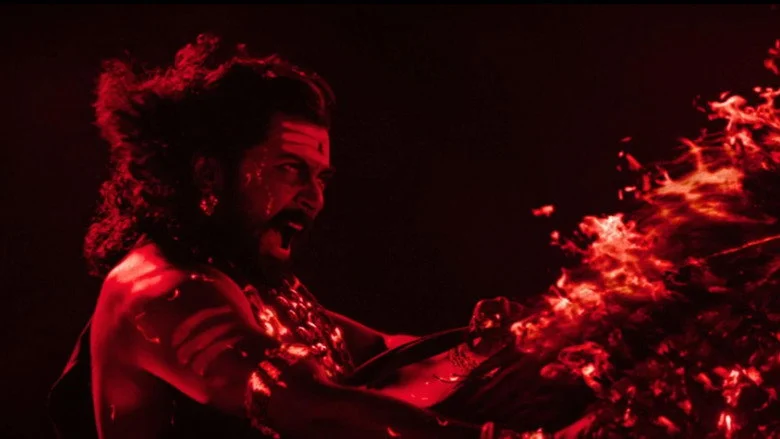
There’s a stretch in the latter half where the mythological god-mode material threatens to derail everything, and Suriya’s sheer screen presence keeps it from becoming a complete disaster. He doesn’t rescue the film, but he makes it watchable in ways the screenplay doesn’t deserve.

RJ Balaji’s Direction: Ambitious Vision, Blunt Execution
RJ Balaji deserves credit for attempting something genuinely unusual, fusing courtroom procedural with folklore and mass-hero grammar. The ambition is visible in every frame, and the first half’s energy suggests he knows how to stage a crowd-pleasing sequence.
But the tonal control slips badly in the second half. The shift from legal argument to god-mode spectacle is blunt, and the screenplay’s predictability starts showing through the cracks. The premise, man challenging a corrupt, god-like power, gets diluted by the very mythology it tries to weaponize.

The Courtroom Is The Genre Engine, Until It Isn’t
The courtroom sequences are where the film’s fantasy-courtroom-drama identity actually works. The staging is argumentative, the framing supports the dialogue-driven escalation, and Suriya’s delivery makes the legal passages feel like action setpieces. It’s the one place where the film’s genre fusion feels intentional rather than desperate.
Then comes the god-mode stretch, and the craft collapses into blunt symbolism. The folklore imagery that worked as texture in the first half becomes the entire point, and the shift is jarring. The balance between human agency and divine power is handled clumsily, the film wants to have both a rational argument and a mythic spectacle, but ends up with neither fully landing.
The editing mirrors this problem. The first half is described as entertaining and better paced, while the second half loses momentum as the predictable beats pile up. The film’s most compelling genre execution happens early, and the rest is a slow fade from promise to predictability.
Trisha Krishnan And RJ Balaji: The Ensemble That Fades Into The Background
Trisha Krishnan’s presence is noted as part of the lead ensemble, but her role-level impact remains frustratingly thin in the available analysis. She’s positioned as a counterweight to Suriya’s intensity, yet the screenplay doesn’t give her the material to match his courtroom dominance.
RJ Balaji’s dual role as director and supporting actor signals his confidence in the material, but his on-screen presence gets overshadowed by the very star he’s directing. The casting choice makes sense for the film’s identity, but the performance doesn’t leave a distinct mark.
Box Office Vs. Critical Verdict: A Hit That Critics Can’t Fully Endorse
The numbers tell a different story than the reviews. The film opened at Rs 15.50 crore India net, as reported by Indian Express, and crossed Rs 114.05 crore India net within the first week, with worldwide gross hitting Rs 189.05 crore, per Republic World. It’s been reported as the highest-grossing Tamil film of 2026 in trade coverage.
Yet the critical consensus sits at a modest 2.5/5 average across Times of India, New Indian Express, and Moneycontrol. The trade verdict says “Hit, ” but the reviews say “uneven.” One publication called it “a mangled mess, ” while another noted an “entertaining first half but a predictable second.” The film’s biggest praise comes from a quote that captures its best self: “Karuppu is most compelling when man challenges God, not the other way around.”
That’s the tragedy of this film, it knows its best argument, but keeps abandoning it for spectacle. The audience response mirrors the critics: Suriya’s performance and the courtroom moments are praised, while the predictable second half and tonal inconsistency draw the complaints. The film is a commercial success that could have been a critical one too, if it had trusted its own premise more.
For more like this, browse our Tamil Action reviews.
The Verdict: A Hit You Watch For Suriya, Not For The Story
Karuppu is a film that wins at the box office and loses its own argument in the second half. Suriya’s performance is the reason to watch it in theaters or on OTT, his courtroom scenes are genuinely electric, and the first half delivers the mass entertainment it promises. But if you’re looking for a tight, consistent courtroom drama, this isn’t it. The god-mode stretch is a tonal betrayal of everything the film sets up, and the predictability of the second half will test your patience.
Go for Suriya, stay for the courtroom, and accept that the mythological stretch is where the film loses its nerve. Karuppu is a 2.5/5 experience, a hit that could have been a landmark if it had trusted its human drama over its divine spectacle.
For a sharper take on restraint in storytelling, see how Dridam review handles its own narrative limits.
And if you want to see how a film’s energy can survive a weak payoff, PARAYANA verdict offers a different answer to the same problem.