Ganesh spends the first act of Brindavihari doing something deceptively difficult: he plays a man who is happy without irony. The film opens as a love letter to a life that is about to be dismantled.
Srinivasa Raju’s Kannada romantic drama arrives with a premise borrowed from Peter Weir’s The Truman Show and a heart that wants to be entirely its own. What it does with that tension determines whether you leave the theatre moved or merely patient.
A Man Who Loves a Woman, Then a World That Won’t Hold Still
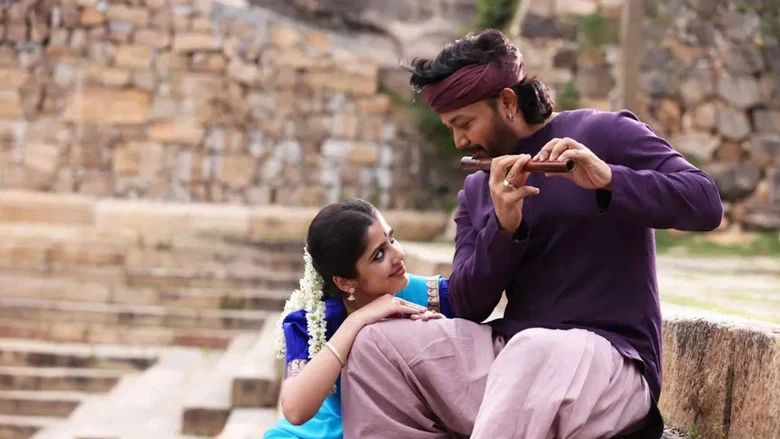
Madhava’s devotion to Radha is established with a warmth that feels almost too comfortable, which is precisely the point. When she leaves, the film does not simply pivot to heartbreak; it pivots to suspicion.
The Brindavanam setting is not decorative here. Raju treats the town as a character with a pulse, and the camera lingers on its lanes and doorways in a way that quietly asks you to pay attention.
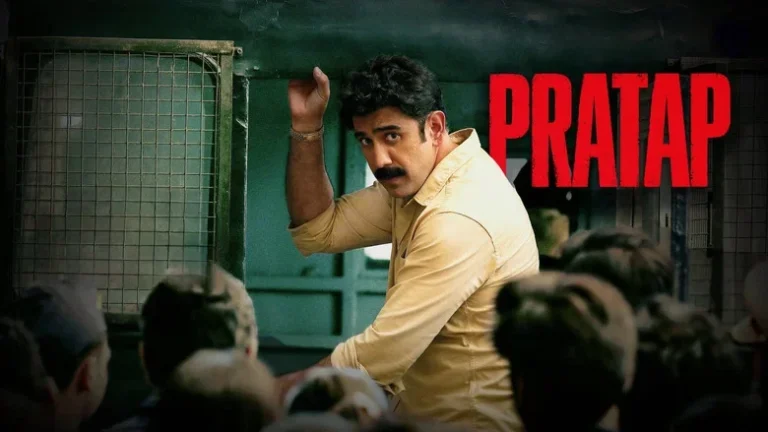
This is where the film’s structural gamble becomes apparent. The romance is the trapdoor, and the mystery is what waits beneath it. Just as the grim procedural mistakes of Pratap were buried under a controlled surface, Brindavihari hides its real question inside a love story that seems content to stay simple.
Meera Arrives, and the Film Starts Asking Questions It Cannot Fully Answer
Malvika Sharma’s Meera is the second emotional axis, and her entrance is staged with a deliberate ambiguity. She is neither clearly a rival nor clearly a savior, and that uncertainty is the engine of the middle section.
The problem is that the screenplay keeps gesturing toward revelation without committing to its cost. Madhava questions his world, but the film too often protects him from the full weight of that questioning.
Where the premise demands a slow tightening, the middle act loosens into a series of scenes that repeat the same emotional note. Ganesh holds the frame with a quiet, wounded stillness, but the writing around him circles rather than advances.
Ganesh’s Restraint Is the Film’s Most Reliable Asset
Watch Ganesh in the quiet moments after Radha’s departure. He does not perform grief with grand gestures; he performs it with a slight delay in his responses, a gaze that lands a half-second late, a body that seems to be listening for something that is no longer there.
That restraint recalls the kind of physical exhaustion that anchors a performance like the one in Kaali Kheti, where the body carries what the dialogue refuses to say.
Devika Bhat’s Radha is a presence defined by absence, and the film uses her sparingly enough that her memory retains its power. Malvika Sharma, by contrast, is asked to carry too much narrative function and is given too little interior life to do it with.
Among the supporting performers, Achyuth Kumar registers in a handful of scenes with the kind of grounded, unshowy authority that makes a fictional world feel lived-in. The rest of the ensemble, including Rangayana Raghu and Lakshmi, are largely left to function as texture rather than as characters with their own arcs.
Raju’s Direction Finds Its Footing in Silence and Loses It in Explanation
The film’s strongest passages are its quietest. Raju has an instinct for holding a shot a beat longer than expected, letting a doorway or a face carry the emotional weight that the script is reluctant to articulate.
But when the film moves toward its central revelation, the camera becomes restless in a way that betrays anxiety. The editing quickens, the score swells, and the film begins to explain what it had previously been content to suggest.
That shift is the difference between a drama that trusts its audience and one that fears them. The musical format, which should be an asset in a story about emotional interiority, is used inconsistently, with songs sometimes deepening the mood and sometimes interrupting it.
The film’s ambitions place it in conversation with a broader wave of contemporary Kannada dramas that are reaching for psychological complexity, and Brindavihari clearly wants to belong to that company.
A Reality-Based Premise That Stops Short of Its Own Implications
The Truman Show comparison is unavoidable, but the film is less interested in the mechanics of a constructed world than in the emotional consequences of discovering one. That is a legitimate choice, and at times a moving one.
Yet the screenplay never fully commits to the implications of its own premise. The revelation, when it comes, is handled with a softness that undercuts the existential vertigo the story has been building toward.
Madhava’s confrontation with the truth should be the film’s most destabilizing sequence. Instead, it plays as a resolution, as though the discovery of a constructed reality were something that could be neatly integrated rather than something that should shatter a person.
The genre sibling Aakasamlo Oka Tara showed how a drama can commit to its emotional register without flinching, and that comparison makes Brindavihari’s hesitation more visible.
KVC Productions and Virat Sai Creations Bet on a Star, Not a Spectacle
For KVC Productions and Virat Sai Creations, this is a calculated bet on Ganesh’s enduring pull with Kannada audiences rather than on scale or spectacle. The film’s budget-conscious production values are visible, but they are not the problem.
The commercial question is whether the romantic-musical format can sustain a mystery-driven narrative in a market that increasingly rewards either pure spectacle or pure intimacy. Brindavihari sits awkwardly between those poles.
Ganesh remains a reliable theatrical draw, and his presence gives the film a floor that a lesser star could not provide. But the film’s refusal to fully commit to its own strangeness limits its ceiling.
The Ending Resolves the Plot but Not the Question
What lingers after the credits is not the revelation itself but the sense that the film pulled its final punch. Madhava’s journey ends in a place of emotional clarity, but the world he inhabits remains stubbornly unexplained.
That may be intentional, an argument that love matters more than the machinery of reality. It may also be a failure of nerve.
Brindavihari is a film with a real performance at its center and a real idea at its edges, and it never quite lets the two meet. Ganesh deserves a film that trusts him to carry the full weight of the question, and this one only asks him to carry the answer.