The most telling image in Varun V. Sharma’s new film is not a declaration of love but a tray of tea carried across an empty marble corridor.
Ranjan Dubey, forty years old and the sole breathing occupant of an ancestral Lucknow mansion, has arranged his solitude so thoroughly that domestic help arrives as an intrusion upon routine rather than a relief to it.
When Aditi Rao Hydari’s Helen steps through that doorway with a Delhi property manager’s clipboard and a professional objective, the film has its entire engine in place. What it does with that engine is the question.
A House Too Large For One Man Is A Premise, Not A Plot
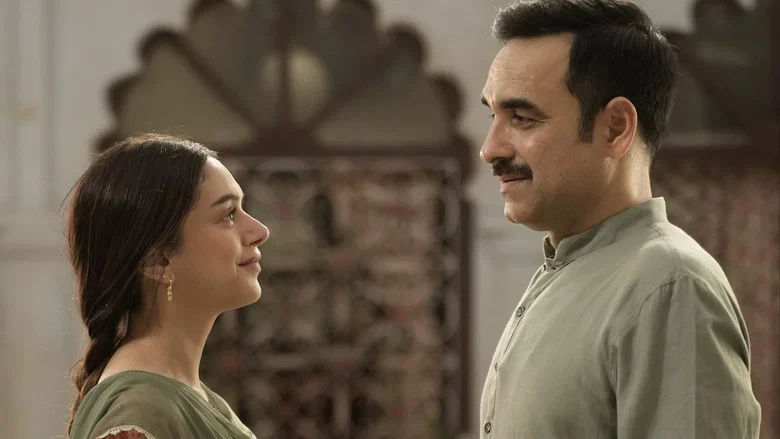
The opening act establishes Ranjan’s bachelor contentment with deliberate, unhurried patience. A well-wisher, Brijendra Kala, hovering in doorways with the fussy persistence of a man who has appointed himself guardian of his neighbour’s marital status, attempts to arrange a match that collapses before it begins.
That failure is the film’s first honest comic beat, and it works because Kala plays the matchmaker’s defeat as a personal wound rather than a plot device. The screenplay, co-written by Sharma with Kala and Ali Abbas Zafar, then hands Helen the house keys and essentially asks the audience to wait.
Waiting is where the trouble begins. The employer–house manager structure gives the film forced proximity, but forced proximity is a condition, not a conflict. The screenplay keeps mistaking the mansion’s scale for dramatic stakes.

When Chemistry Must Do The Work Of A Missing Antagonist
There is no villain here, and that is a defensible choice. Social prejudice and the marriage-industrial complex are the opposing forces, and the film treats them as ambient pressure rather than a named adversary.
The cost is steep. Without a figure to push against, the second act drifts into domestic vignettes that are pleasant, observant, and dramatically inert. The relationship advances through shared meals and household negotiation, but the film never quite locates the moment where affection becomes dangerous to Ranjan’s carefully managed life.
Sharma’s direction favours stillness, and the contained geography of the mansion does create a genuine visual argument: inherited space dwarfing a single occupant, rooms that echo. But the film’s refusal to escalate means the prejudice it wants to indict never acquires teeth.
The screenplay’s central mechanical risk, converting an employment arrangement into mutual romance while addressing the power imbalance between them, goes largely unexamined. Helen’s professional independence is asserted in dialogue and then quietly absorbed into the household’s rhythms.
Tripathi’s Stillness And Hydari’s Guarded Warmth
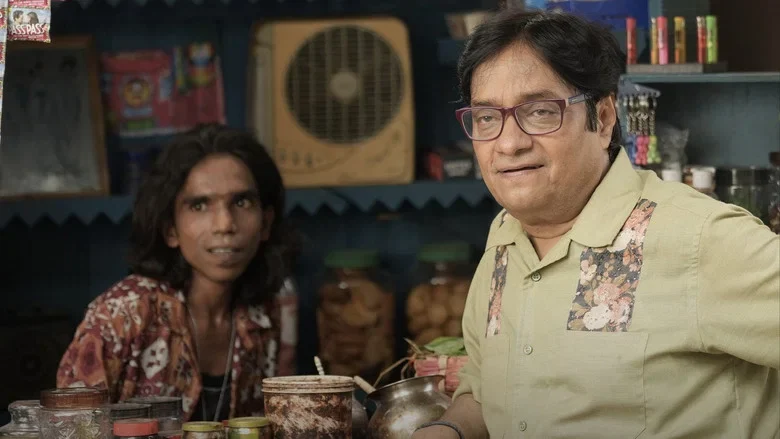
Tripathi builds Ranjan from small physical decisions: the way he occupies a chair as though claiming territory, the pause before he answers a question about marriage, the comic timing of a man who has learned to deflect concern with mildness. It is a performance of subtraction, and it is very good.
His challenge is making isolation legible before Helen arrives, and he does it by playing contentment as a kind of armour. The shift into emotional dependence is where the writing lets him down, the script skips the intermediate stages and asks us to accept the transformation on faith.
Hydari’s Helen carries the film’s perspective on independence, and she plays the professional competence with a crispness that makes her domestic tasks feel like a demotion the character has chosen. Her stillness opposite Tripathi’s deflection produces the film’s best moments.
What the film lacks is the pressure that made Tripathi’s work in Mirzapur so unnerving, the sense of a man whose gentleness might be a mask. Here the gentleness is the whole man, and the film never tests it.
Proximity Without Friction Is Just Real Estate
The romantic-comedy mechanics are all present: the failed matchmaking setup, the outsider’s arrival, the mismatch between Helen’s practical assignment and Ranjan’s entrenched routine. What is missing is the friction that turns proximity into desire.
Contemporary Hindi comedy has been increasingly willing to let domesticity carry emotional weight, and this film belongs to that lineage. The comparison to DNK is instructive precisely because that film understood that a contained premise needs a ticking clock, not just a charming location.
Here the ticking clock is social expectation, but the film treats it as background noise. The result is a romance that feels like a series of pleasant afternoons rather than a story with a destination.
The Banality Problem Is Structural, Not Incidental
The film’s most persistent weakness is tonal: it wants to be gentle and ends up weightless. The family-drama elements that should expand the stakes, the question of whether this relationship can survive public judgment, arrive late and resolve easily.
That ease is the film’s quiet betrayal of its own theme. A story about the right to define relationships outside convention needs to show the cost of that definition, and this one mostly shows the comfort.
The Lucknow setting and ancestral-mansion premise provide a recognisable family-entertainer framework, and audiences seeking that framework will find it competently assembled. Those seeking a sharper argument about class, age, and female independence will find the film gesturing toward those questions without pressing them.
Where the screenplay does earn its keep is in the small observational textures of shared domestic life. The film is at its best when it is simply watching two people negotiate a kitchen.
The OTT Calculus And What It Says About The Slate
Bhanushali Productions and AAZ Films have positioned this as a direct Sony LIV premiere rather than a theatrical release, and that decision reads as commercially rational. A contained, performance-led romantic comedy with no action set-pieces has limited theatrical upside in the current exhibition market.
For Tripathi, the film extends a run of leading roles built on his particular register of mild, observational comedy. It does not test his range, but it confirms his drawing power with family audiences on streaming platforms.
The franchise logic here is not sequel potential but slate-building: Sony LIV is assembling a library of Hindi family entertainers, and this film fits that mandate cleanly. Whether it moves subscribers is a question the platform’s data will answer privately.
A Gentle Film That Needed To Be Braver
The film’s resolution, a turn toward companionship and family acceptance, is thematically coherent and emotionally soft. It argues that relationships can be redefined by the people inside them, and it makes that argument without much resistance.
That softness is the film’s limitation and its charm. It is a story about an isolated man learning to share a house, told with genuine affection for its characters and genuine reluctance to make them suffer.
What lingers is not the romance but the mansion itself: too many rooms, too much silence, one man learning that the echo was never the point. The film wants to say that companionship is worth the disruption of a settled life, and it says so quietly, in a house that deserved a louder argument.