The opening conceit lands with a refreshing jolt: a groom, not a bride, packs his bags and moves into his wife’s family home. Pyaar Prema Kalyanam establishes its role-reversal premise in the first act with clarity that many bigger-budget romances fumble, setting up a domestic battlefield where tradition meets individual choice.
Director Elan, doubling as the lead, has constructed a film that knows exactly what it wants to say about marriage as a partnership of equals.

Elan’s Double Duty: Director and Husband in One Frame
Elan the director gives Elan the actor a character that functions as the tonal anchor of the entire premise. His performance is calibrated for situational comedy rather than dramatic fireworks, which suits the film’s light family-entertainer ambitions.
The husband’s awkward adaptation to his wife’s household becomes the comic engine, and Elan sells the discomfort with a straight-faced earnestness that keeps the setup from tipping into farce. His screen presence holds the film together even when the writing around him settles into familiar patterns.
A Screenplay That Negotiates, Not Confronts
Elan’s greatest strength here is premise construction. The central conflict – a couple defending their unconventional living arrangement against family pressure – is introduced with admirable economy. The linear screenplay keeps the stakes personal rather than external.
But the middle passages reveal a specific flaw: the family-chaos sequences rely on domestic-comedy templates we have seen many times before. The escalation never surprises, and the film coasts on the strength of its hook rather than fresh comic invention.
The Genre-Core Execution: Romance Through Domestic Negotiation
As a romantic comedy, Pyaar Prema Kalyanam wisely keeps its romance rooted in relationship negotiation rather than grand gestures. The chemistry between Elan and Saanve Megghana’s Pavi builds through small domestic compromises – the kind of quiet adjustments that define real marriages. The marriage-arrangement reveal, where the husband moves into the wife’s home, functions as both the film’s most praised scene and its thematic thesis.
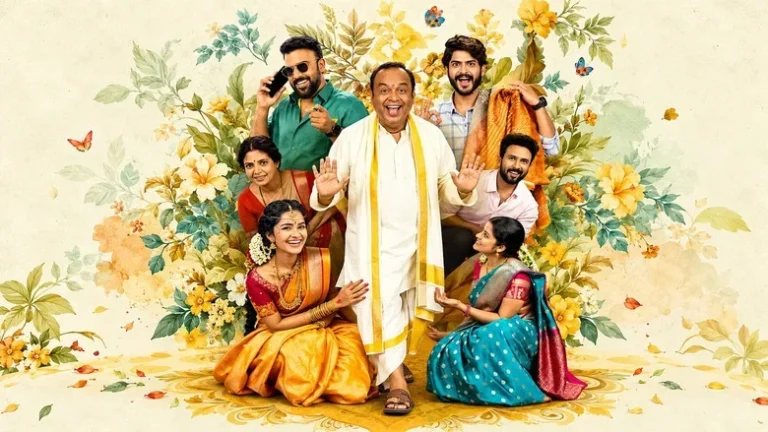
The comedy derives from ensemble reactions to this reversal, with relatives functioning as a chorus of traditional expectations. Yogi Babu’s casting signals the film’s commitment to lighter comic relief, and M. S. Bhaskar’s presence suggests the elder-character dynamics that anchor the family friction.
What the film does better than many recent Tamil rom-coms is keeping the conflict internal to the household. There is no external villain, no convenient plot machinery – just the slow, sometimes awkward work of two people defending their choice against the weight of expectation. That restraint is both the film’s virtue and its limitation, as the dramatic stakes stay modest throughout.
Supporting Cast: Familiar Faces, Familiar Functions
Saanve Megghana carries the female lead with a presence that makes the role-reversal premise believable. Her Pavi is not a caricature of the modern woman but someone whose refusal to leave her family home feels rooted in genuine attachment, not mere rebellion. Radhika Sarathkumar’s inclusion suggests a family authority figure whose reactions will shape the conflict’s resolution.
Yogi Babu and M. S. Bhaskar are positioned as comic support, and their casting signals the film’s intent to keep the tone light. Neither actor is given material that breaks new ground, but their familiarity serves the film’s family-entertainer ambitions. The ensemble functions as a safety net, ensuring that even the weaker comic passages land with some warmth.
Audience Reception: A Premise That Resonates
With no verified critic consensus or box office reporting available, the film’s reception rests on what audiences are likely to latch onto: the unconventional marital setup and the family-comedy tone. The social media conversation, as far as can be gathered, points to appreciation for the role-reversal concept and the mix of lead performers with familiar supporting actors.
The absence of controversy is notable. This is a film designed to provoke gentle reflection, not outrage – a story about marriage that asks whether tradition should define happiness, without ever turning that question into a polemic. The potential criticism lies in the familiarity of the domestic-comedy beats, which may leave viewers wanting more dramatic depth than the premise promises.
For those who enjoy Tamil romantic comedies with a distinct hook, this one deserves a watch. For those seeking heavier drama, the film’s modest ambitions may feel thin.
Pyaar Prema Kalyanam is a light, well-intentioned family entertainer that asks the right questions about marriage without pushing its answers too hard. I found myself wishing the middle passages had matched the boldness of the opening setup. Still, for a film that wears its heart on its sleeve, it earns a solid 3 out of 5 – a pleasant OTT watch that respects its audience’s intelligence without demanding too much of it.
For more Tamil Romance reviews, browse our extensive coverage.
If the role-reversal premise intrigues you, Irumudi review explores a similar theme of unconventional family dynamics.
For another take on domestic conflict and emotional stakes, Khalifa Part verdict offers a different kind of family struggle.