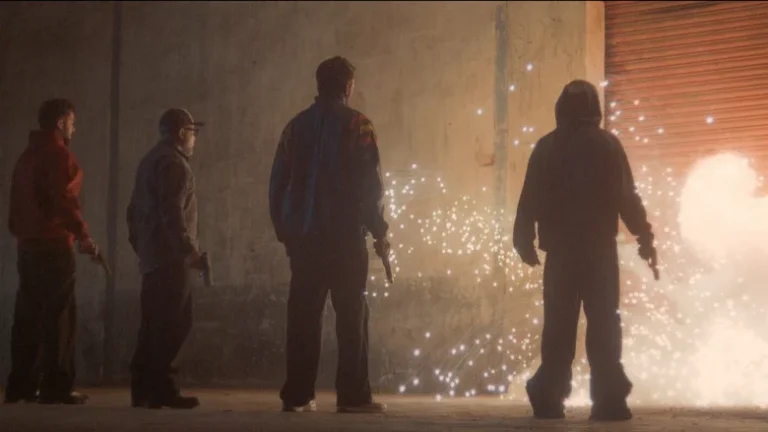
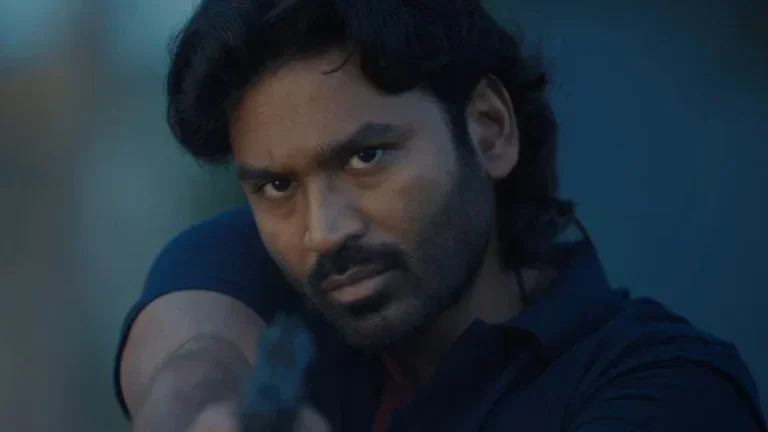
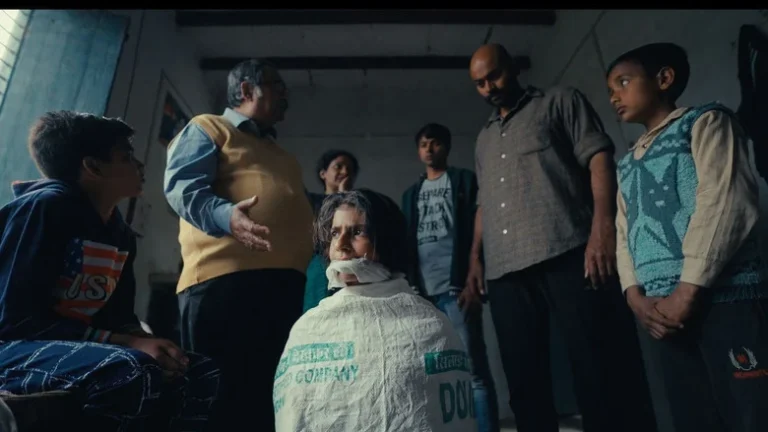
The horseman rides into the cave mouth with an army at his back, and Sundar C cuts to a queen who understands exactly what the warning costs her. She pays it anyway.
That opening sequence is the most confident thing in Mookuthi Amman 2: Maha Sakthi, and the film spends the next two hours trying to earn it back.
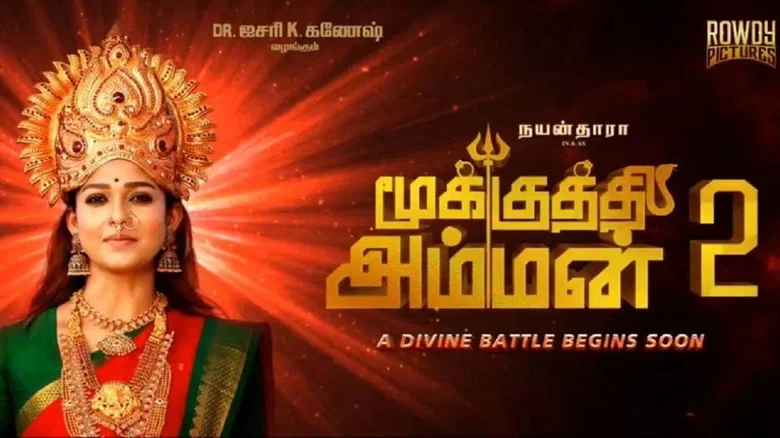
A Sacrifice That Sets Stakes The Present Day Cannot Match
The period prologue works because it is ruthlessly simple: a kingdom, a child, a mother who trades her life for both. No dialogue is wasted explaining the rules of the world.
Then the film jumps forward, and the confidence evaporates into a present-day calamity that arrives with considerably less clarity about what it actually is.
The sequel’s structural gamble is the dual timeline, and it is a genuine escalation from the 2020 original’s single-setting devotional comedy. The problem is that escalation has outpaced the writing’s ability to connect the two halves.
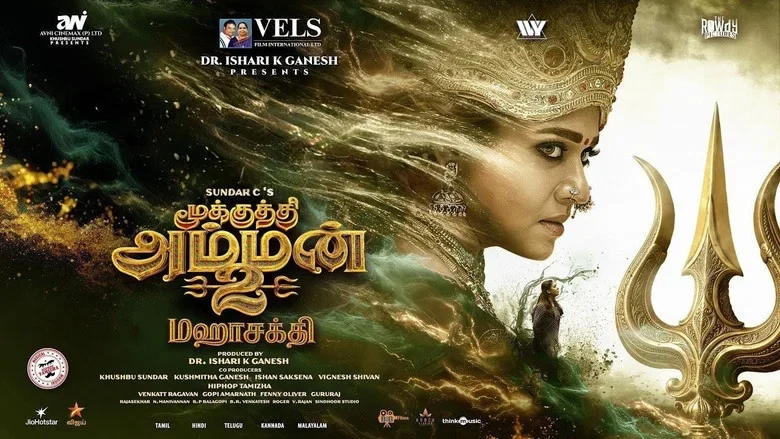
Regina Cassandra Builds A Villain The Script Refuses To Define
Regina Cassandra has the film’s most interesting assignment and the least support. Her sorceress moves through the frame with a stillness that reads as genuine menace, a slow turn of the head, a gaze held a beat past comfort.
But the screenplay never establishes the rules of her power. What can she do? What does she want beyond the generic accumulation of “new evil”? Without constraints, her confrontation with the goddess has spectacle but no suspense.
An antagonist who can do anything is an antagonist who threatens nothing. That is the central mechanical failure here, and no amount of committed physical performance from Cassandra can paper over it.
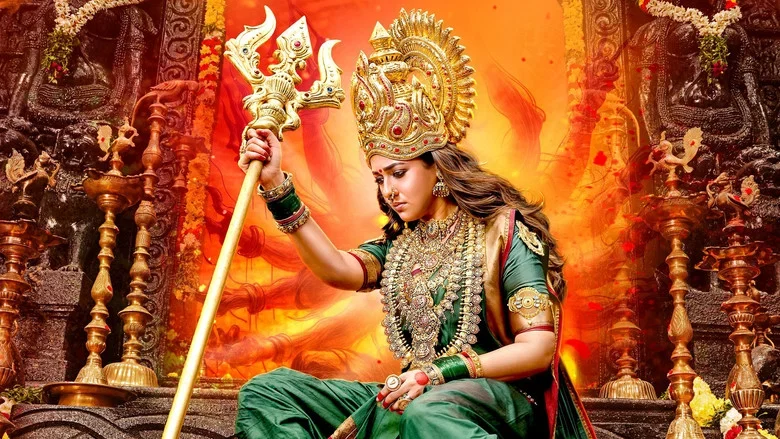
Nayanthara Holds The Centre, But The Centre Is Crowded
Nayanthara remains the film’s gravitational pull. Watch her in the protective passages: the chin lowering, the shoulders squaring, the voice dropping into a register that suggests authority rather than volume.
She is asked to carry maternal responsibility, divine authority, and a present-day officer’s disguise simultaneously, a triple load the script distributes unevenly across the runtime.
The restraint she brings to the more vulnerable beats recalls the psychological weight of her turn in Toxic, where stillness did the work that dialogue could not. Here, she is often left waiting for the material to catch up.
Around her, the ensemble functions largely as texture. Urvashi lands a handful of comic beats with her usual timing, while Yogi Babu is deployed so episodically that his presence registers as punctuation rather than character.
Sundar C’s Architecture Works Until It Has To Connect
Sundar C knows how to build commercial fantasy scaffolding. The period imagery is staged with real scale, the cave, the horseback approach, the massed army, and Gopi Amarnath’s camera holds the mythological register without over-decorating it.
Just as he demonstrated tighter spatial discipline in Disco, the director strips away ornamental moves in the confrontation scenes to prioritise raw friction between the two women.
What he cannot solve is the tonal traffic jam. Comedy, mythological action, thriller mechanics and devotional drama all demand space in a runtime that keeps expanding to accommodate them, and the transitions between registers grow increasingly visible.
The screenplay resists the kinetic sensationalism that overtook Ramayana, opting instead for a deliberate, sometimes suffocating dread. The intent is admirable; the execution leaves long stretches where the air goes out of the room.
Vels Film International Bets Big On A Diwali Franchise
Vels Film International, in association with Rowdy Pictures and Avni Cinemax, has positioned this as a tentpole, a Diwali release with mythological scale and a female star at its centre.
That is a meaningful bet on franchise sustainability in a market where the regional sequel pipeline is increasingly crowded and original IP is fighting for oxygen.
Nayanthara’s theatrical leverage is real, but it is leverage built on devotional intimacy rather than period spectacle, and this film asks her audience to follow her into considerably more expensive territory.
The commercial question is whether that audience wants a goddess who fights sorceresses, or a goddess who sits at a kitchen table and argues about faith. The first film knew the answer. This one seems less certain.
A Divine Battle That Arrives Without Consequence
The climax delivers the advertised confrontation, and it is staged with adequate scale. What it lacks is the thing the prologue had in abundance: a sense that something irreplaceable is being risked.
The queen’s sacrifice in the opening minutes lands because it costs her everything. The final battle lands because it costs the film a great deal of money.
That is the distance between mythology and merchandising, and Mookuthi Amman 2 spends its runtime drifting from one toward the other. This patient character study signals a welcome tonal maturity across contemporary tamil fantasys, but maturity without structural rigour is just a longer film.
Nayanthara deserves a franchise that trusts her stillness as much as its own spectacle. On this evidence, the goddess has outgrown the mythology built to contain her.