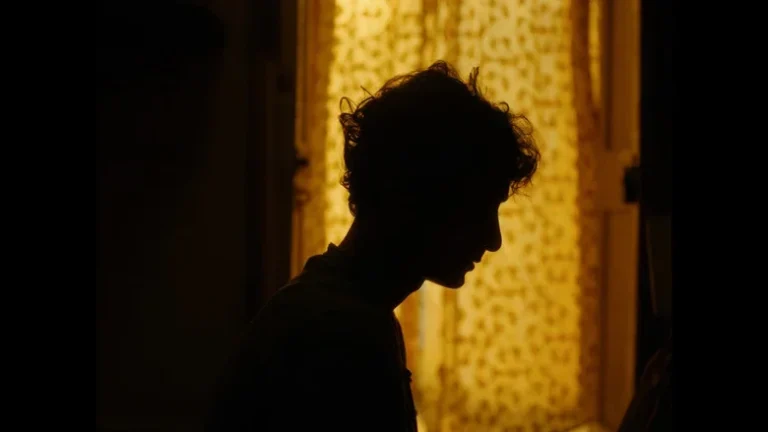
The film opens on a Goa balcony at dusk, Harish Kalyan’s Vino half-turned from the camera, and for a moment the stillness suggests Sasi might be reaching for something genuinely interior. Then the voiceover starts explaining the feeling, and the spell breaks.

A Broadcasting Premise That Sets Up A Romance It Can’t Fully Earn
Sasi builds his central relationship on a clean professional hook: Vino, an ambitious television broadcaster, relocates to Goa chasing a career opportunity and a fresh face for his upcoming programme. That search leads him to Fenny, and the screenplay wisely makes her a collaborator before a love interest.
It’s a sturdier foundation than most Tamil romances get. The problem is what Sasi builds on it.
The film’s dramatic engine is meant to be the friction between Vino’s professional drive and the emotional demands Fenny places on him, a tension that surfaces in the way he keeps checking his phone during what should be a quiet dinner with her. That gesture lands. What surrounds it often doesn’t.
Where a leaner film might have trusted the silences between these two, this one keeps reaching for explanatory dialogue. The contrast with how Mookuthi Amman 2 collapses under the weight of its own mythology is instructive: this film’s failure is smaller, quieter, more forgivable, but it’s the same instinct to over-narrate what should be felt.

Harish Kalyan’s Vino Is A Study In Withheld Emotion, Until The Script Won’t Let Him Withhold
Kalyan’s best work here is physical. Watch how Vino’s shoulders drop half an inch when Fenny walks into the studio, or the way he laughs a beat too late at her jokes, as if calibrating whether the sound is appropriate.
These are the micro-adjustments of a man negotiating between what he wants and what he thinks he’s allowed to want. When the script lets Kalyan sit in that discomfort, the film briefly becomes something sharper than its synopsis.
Then the third-act confrontations arrive, and Sasi hands his lead actor pages of dialogue that explain the subtext rather than dramatise it. Kalyan delivers them with conviction, but conviction can’t rescue a line that tells us what his face already said better.
The restraint he shows in the quieter stretches recalls the controlled exhaustion Siddhi Idnani brought to Drones, another performance that trusted small gestures over big declarations. Here, Idnani’s Fenny is warmer, more openly emotional, and the two actors have a genuine ease with each other that the film doesn’t always know how to use.

Siddhi Idnani Finds The Interior Life The Script Occasionally Forgets
Fenny is written as the more emotionally available partner, which risks making her a foil rather than a character. Idnani resists that by playing her silences as active choices.
In one early scene, she listens to Vino describe his career plans with a smile that doesn’t quite reach her eyes, and the camera holds long enough for us to see her recalibrating what she expected from him. It’s a small, precise piece of acting that does more character work than several pages of dialogue.
Late in the film, when the misunderstandings pile up, she has a moment of stillness in a doorway that’s the closest the film comes to genuine heartbreak. The screenplay doesn’t earn it. She does.
Supporting Ensemble Fades Into The Background When The Film Needs Them Most
Kovai Sarala and Thambi Ramaiah appear in the kind of familial roles that Tamil cinema has long used as emotional anchors, but Sasi gives them little to do beyond reacting to the central couple’s turbulence.
Sarala has one scene where she quietly observes Vino during a family gathering, her expression shifting from concern to resignation, and it’s a reminder of what the film could have been if it trusted its supporting cast with actual dramatic function. Mostly, they’re asked to fill space.
The ensemble suggests a wider social world pressing on the relationship, but the screenplay never clarifies what that pressure actually is. Family expectations are referenced, not dramatised. Social context is implied, not examined.
The result is a romance that feels sealed off from the world around it, which is a curious choice for a film that seems to want to say something about modern relationships. The thematic ambitions of Nizhalilirundhu Velicham, for all its structural fragility, at least committed to a specific emotional argument. This one hedges.
Sasi’s Direction Finds Rhythm In Conversation, Loses It In Transition
The director’s strength has always been his ear for the way people talk past each other, and there are stretches here where the dialogue scenes find a genuinely uncomfortable rhythm. Vino and Fenny’s arguments have the messy, circular quality of real fights, where both people are right and both are wrong.
Where Sasi struggles is in the connective tissue. Scene transitions often feel abrupt, as if the film is impatient to get to the next emotional beat without earning the journey. A scene of reconciliation is followed immediately by a new complication, and the whiplash prevents either moment from landing.
Siddhu Kumar’s score is deployed sparingly in the first half, which works, but grows more insistent as the film loses confidence in its own silences. By the final act, the music is telling us how to feel about scenes that haven’t done the work to make us feel it.
The cinematography, credited to no one the available materials identify with confidence, makes the most of Goa’s soft light during the romantic passages but never develops a visual language that comments on the story. It’s pretty. It’s not expressive.
A Digital Release That Sidesteps The Box-Office Question Entirely
Nooru Kodi Vaanavil arrives on ZEE5 Global after a production delay that reportedly stretched several years, and the direct-to-digital strategy makes commercial sense for a mid-budget romantic drama without major theatrical hooks.
For ZEE5, the film represents a safe content play: recognisable Tamil faces, a contemporary relationship premise, and a runtime that fits comfortably into the platform’s viewing patterns. The question is whether it moves the needle for subscribers in a crowded streaming market.
For Harish Kalyan, this is a low-risk entry in a filmography that has been building steadily toward leading-man status. The performance won’t hurt him. It might not particularly help him either.
The broader Tamil drama landscape, as the streaming ecosystem continues to absorb mid-budget films that once would have had modest theatrical runs, benefits from having more character-driven work available to audiences. Whether this particular film finds an audience depends less on its quality than on whether ZEE5’s algorithm surfaces it to the right viewers.
This patient, conversation-heavy approach to romance represents a modest step in the evolution of contemporary Tamil dramas, even when the execution falls short of the ambition.
The Ending Resists Resolution, Which Is Either Integrity Or Indecision
Without disclosing specifics, the film’s final act refuses the clean reconciliation that the genre often demands. Vino and Fenny’s choices leave them in a place that’s neither together nor fully apart, and Sasi seems to be arguing that some relationships exist in a permanent state of almost.
It’s a defensible choice, and it’s the moment where the film’s refusal to over-explain finally works in its favour. The last shot holds on a face that’s processing something we’re not privy to, and for a few seconds, the film trusts us to sit with that ambiguity.
But ambiguity only resonates if the journey toward it has been fully dramatised, and too much of this relationship’s interior life has been described rather than shown. The ending feels less like a deliberate open question and more like a film that ran out of time to answer its own.
Nooru Kodi Vaanavil is a romance that understands the shape of heartbreak without always finding its texture. Kalyan and Idnani deserve a sharper vehicle, and Sasi, at his best here, shows he might be the one to build it next time.